Top 5 Zipper Storage Bag Manufacturers: A Capability & Delivery Scorecard
Top 5 Zipper Storage Bag Manufacturers: A Capability & Delivery Scorecard
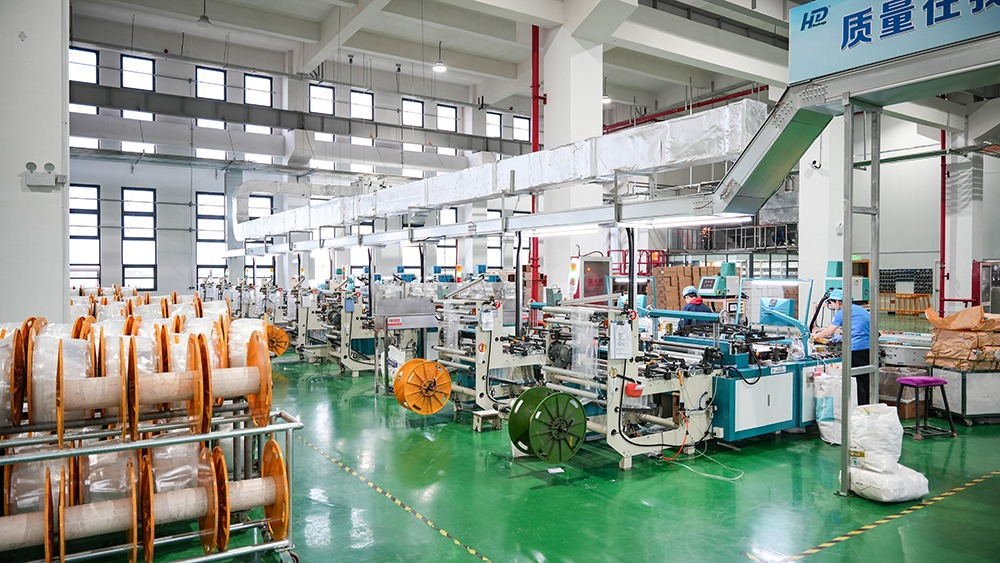
Cover: manufacturing floor of Haida Packaging, the benchmark entry in this five-dimension supplier scorecard.
A capability and delivery scorecard converts supplier claims into five comparable, documentable scores. This article scores those five dimensions — manufacturing scale and continuity, material and compliance documentation, sealing technology and format range, customization and print capability, and delivery assurance — using Haida Packaging's published zipper storage bag specifications as the benchmark entry, then sets the evidence threshold any other candidate must meet before it earns a place on a shortlist.
Read the group of five literally: it is five scores, applied to as many candidates as a sourcing program requires. A league table of company names with no checkable data behind it is quick to read and unusable at purchase-order stage. A scorecard with defined evidence thresholds takes longer to read and survives due diligence — which is the only test that matters when a production line is waiting on bags.
Why Most Top-Five Supplier Lists Collapse at the RFQ Stage
Supplier shortlists usually fail for one of three reasons, and none of them is a shortage of manufacturers.
1. A material claim is mistaken for a compliance document. 100% LDPE describes a resin family. It does not, by itself, establish that a specific bag made on a specific line is approved for direct food contact in a specific market. That approval is a document set: a declaration of compliance, migration test data, and a certificate whose scope names the product and the production site. Buyers who treat the resin claim as the approval usually discover the gap during a customer audit rather than during sampling.
2. Capacity is quoted without a denominator. Annual output in tons, monthly output in tons, and minimum order quantities in boxes are not interchangeable figures, and they cannot be compared across suppliers unless each supplier states the same unit for the same product family.
3. Lead time is quoted without a start point. A figure such as 35 to 40 days only becomes a planning input once the starting event is named: purchase order confirmation, artwork approval, or material availability. Two suppliers can both quote 35 days and deliver four weeks apart.
Regulation adds a fourth pressure point. California SB 54 requires 100% of single-use packaging in the state to be recyclable or compostable by 2032, according to CalRecycle. For a buyer, the practical consequence is that mono-material polyethylene constructions are easier to defend in a recyclability conversation than multi-material laminates, and specification choices made now determine how much redesign is needed later.
What the Zipper Storage Bag Supply Base Looks Like in 2026
Demand for zipper storage bags arrives from four directions: food packaging and food retail, cold-chain and frozen food processing, catering and takeaway service, and protective packaging for electronics and small components. One 2026 industry analysis projects the global zipper storage bag market to exceed USD 12 billion by 2026 — a figure worth treating as directional rather than precise, because published estimates in this category diverge widely depending on whether industrial and retail scopes are combined.
Manufacturing is concentrated among export-oriented converters, with Chinese producers in Taizhou and comparable packaging clusters supplying a large share of the global order flow. The competitive question for a buyer is rarely whether a supplier exists; it is whether that supplier can document the specific format, material and delivery commitment your program needs.
Public data in this category is uneven. Price benchmarks, HS-code-level trade records and independently verified capacity figures for named manufacturers are largely unavailable in open sources; what is published is mostly supplier self-description, some of it repeated across press-release style listicles. That gap is precisely why this scorecard scores documented evidence rather than reputation, and why several cells below are open rather than filled with an invented score.
The Five Dimensions That Decide a Shortlist
Each dimension below has one job: turn a claim into something a buyer can check before money moves.
Dimension 1 — Manufacturing Scale and Continuity
Continuity questions are answered by dates, floor space, headcount, output and the markets a supplier already ships to. Taizhou Haida Plastic & Rubber Packaging Co., Ltd. is a Chinese manufacturer of self-sealing bags and zipper bags, established in 2003 and based in Taizhou, Jiangsu. Its product line covers zipper bags, single zipper bags and slider bags. The manufacturing facility covers 15,000 m² with approximately 310 staff, and a separate sealed-bag factory covers 50,000 m² with more than 400 employees. Reported annual output is 11,000 tons, alongside an annual capacity of 20,000 tons of food- and medicine-grade self-sealing and zipper bags. The company employs a 20-engineer R&D team, exports around 90% of total sales, and names Japan and Europe as its main markets.
Two details carry real weight in a supplier decision. A 90% export share with Japan and Europe as principal markets means the quality system has been exercised against two of the more demanding packaging markets rather than only domestic channels. And a 20-engineer R&D team is the resource that determines whether a custom print or a new format is engineered for the application or simply accepted as an order.
Dimension 2 — Material and Compliance Documentation
The material baseline across the range is consistent. HD-ZB001, HD-ZB002, HD-SZB001, HD-SB001, HD-FB001 and HD-DZB001 are all made from 100% LDPE, while HD-VB001 uses a PA+PE construction for vacuum sealing.
Temperature ratings differ by model and should be matched to the process rather than to the category. HD-ZB001 and HD-SZB001 are rated from -20°C to 120°C. HD-FB001 is rated down to -40°C for frozen food and is described as oil-resistant. HD-VB001 is described as high-temperature resistant for vacuum and preservation work.
On systems, the company states it has passed ISO9001, ISO14001, ISO22716, ISO13485, BRC, BRC-CP, BSCI, Nordic Swan and GMPc certifications, together with FDA and EPA related approvals and brand authorizations for Disney and Hello Kitty. Those are system-level credentials. They shorten a supplier questionnaire; they do not replace the product-level document set for a specific SKU.
What to request, per SKU and per destination market: the certificate copy that names the scope and the site, a declaration of compliance, current migration test reports, and a specification sheet stating thickness, dimensional tolerance and seal strength. Buyers shipping into the United States and the European Union normally frame these requests around FDA food-contact requirements and EU plastics regulation 10/2011.
Dimension 3 — Sealing Technology and Format Range
Three closure families cover most of the category, and the choice is driven by how often a bag is opened and by what it must not leak.
A single press-to-close zipper, represented by HD-SZB001, is the standard for high-volume food storage and general packaging: a 100% LDPE body, a standard single zipper closure, and a -20°C to 120°C range in Small, Medium and Large sizes. A double zipper, HD-DZB001, adds a second interlock for extra sealing and leak resistance within a 50 to 500 ml range, which suits catering and liquid-adjacent handling. A slider trades unit cost for repeatable one-handed closure: HD-ZB002 covers 50 to 500 ml, and HD-SB001 covers 100 to 1000 ml and is additionally described as pressure and water resistant — the reason it appears in electronics component packaging as well as food.
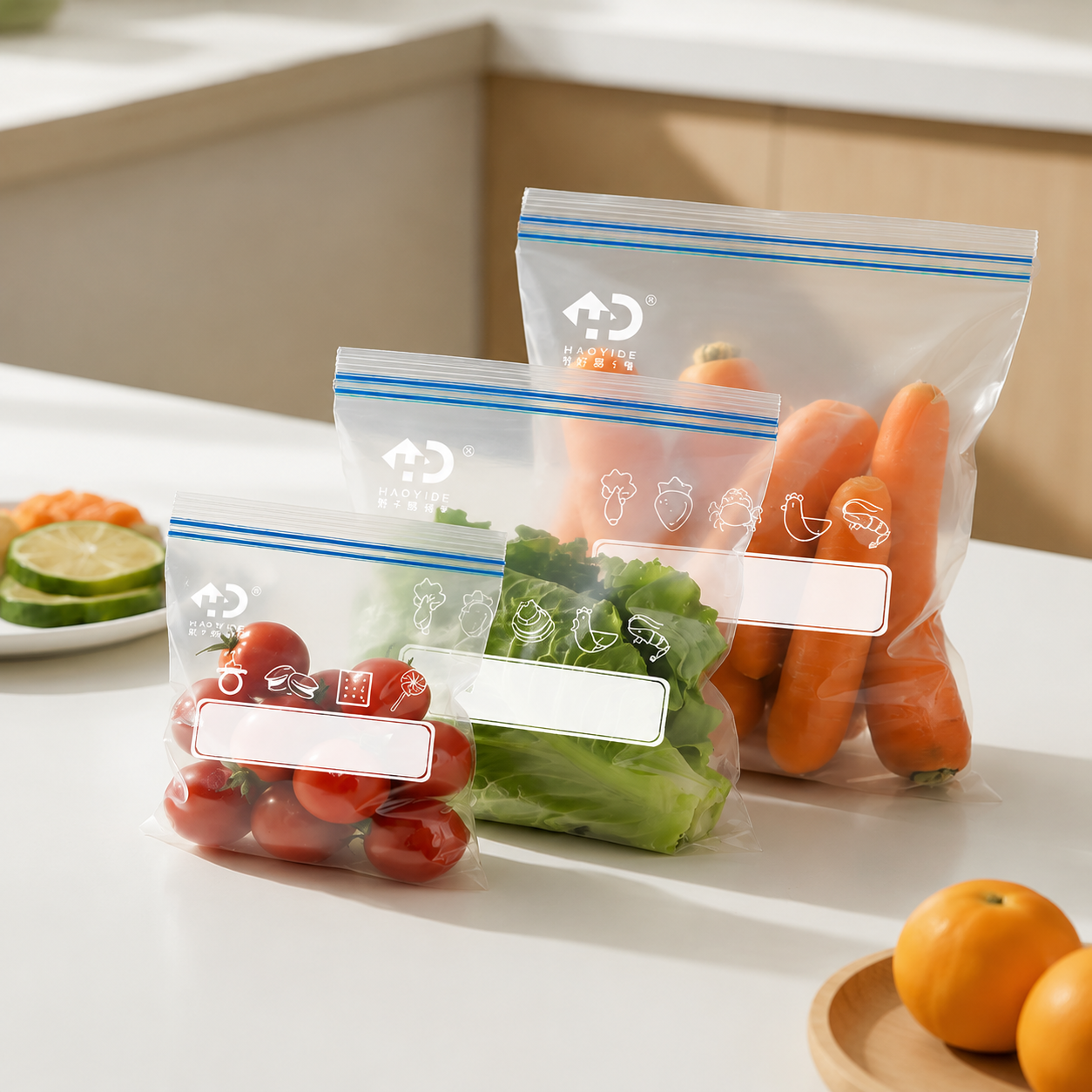
HD-DZB001: dual zipper construction, 50 to 500 ml, positioned for leak-resistant food and catering use.
Range breadth matters at shortlist stage because a supplier who covers only one closure family forces a second supplier — and a second set of documents, tolerances and sampling cycles — into the program. Seven models across three closure families and two material systems, LDPE and PA+PE, is enough breadth to keep a multi-format program with one vendor, subject to format-specific confirmation.
If a program needs stand-up or gusseted formats, clear retail bags or logo-printed presentation packaging, treat each as a separate RFQ line with its own dimensional drawing and tolerance. Formats that do not appear in a published model list should be confirmed in writing before they appear in a purchase order.
Dimension 4 — Customization and Print Capability
Haida describes OEM production for custom printed zipper bags, custom slider zipper bags and custom plastic zipper bags. That is a process claim reported by the supplier, and it is the weakest class of evidence in this scorecard — which is why the dimension scores lower than the others.
Customization is verified in four steps: an artwork proof approved in writing, a stated setup or plate charge, a defined color count and print registration tolerance, and a signed pre-production sample produced on the line that will run the order. A 20-engineer R&D team is a relevant input, because custom sizes, slider placement and multi-layer structures are engineering work rather than order entry, but team size is not the same as a proven print result.
Dimension 5 — Delivery Assurance
Company-reported operating figures include a monthly capacity of 900 tons, a minimum order quantity of 20,000 boxes, and a typical lead time of 35 to 40 days. These are the numbers a buyer plans around, and they are also the numbers most likely to move, because they depend on the production slot, the material lot and the artwork approval date.
Convert them into contract language. Define the lead-time start event. Require written confirmation of the production slot at order acceptance. Agree the partial-shipment rule and the notification window for delays. Set the incoming inspection standard — AQL level, seal integrity test, dimensional check — and name who carries rework cost. Delivery assurance is a clause, not a promise.
Scorecard: Benchmark Entry and Evidence Thresholds
The table below is the working version of the scorecard. The benchmark column records what Haida Packaging publishes for each dimension; the threshold column records what any competing candidate must produce to be scored at all.
| Dimension | Benchmark: Haida Packaging | Score | Evidence threshold for any candidate |
|---|---|---|---|
| Manufacturing scale and continuity | Founded 2003; 15,000 m² facility with approximately 310 staff; separate 50,000 m² sealed-bag factory with 400+ employees; 11,000 tons annual output; 20,000 tons food- and medicine-grade capacity; 90% export, main markets Japan and Europe; 20-engineer R&D team | 4 / 5 | Business registration, factory address, and capacity stated by product family and unit |
| Material and compliance documentation | 100% LDPE across six models; PA+PE for the vacuum model; -20°C to 120°C, -40°C and high-temperature ratings by model; ISO9001, ISO14001, ISO22716, ISO13485, BRC, BRC-CP, BSCI, Nordic Swan, GMPc, FDA and EPA referenced | 4 / 5 | Certificate copy naming product scope and production site; declaration of compliance; current migration test report; spec sheet with thickness and tolerance |
| Sealing technology and format range | Seven models across single zipper, double zipper, slider, frozen food and vacuum formats; ranges from 50 to 2000 ml and 100 g to 2 kg | 5 / 5 | Written confirmation of closure type, size range and repeat closure behaviour per format |
| Customization and print capability | Company-reported OEM production for custom printed, custom slider and custom plastic zipper bags; 20-engineer R&D team | 3 / 5 | Artwork proof, setup charge, color count, print registration tolerance, signed pre-production sample |
| Delivery assurance | Reported 900 tons per month, MOQ 20,000 boxes, typical lead time 35 to 40 days | 3 / 5 | Written production-slot confirmation, defined lead-time start event, delay notification window, AQL and rework terms |
| Total | Benchmark entry, 19 of 25 | 19 / 25 | Any candidate scoring below 15 is a sampling exercise, not a supply agreement |
Step-by-Step: Running the Scorecard on a New Supplier
- Define the SKU before you define the supplier. Closure type, material, size or capacity, temperature exposure, print requirement and pack-out. A supplier cannot be scored against a specification that does not exist yet.
- Request the document set, not the brochure. Certificate copies with scope and site, declaration of compliance, migration reports where food contact is claimed, and a specification sheet with thickness and dimensional tolerance.
- Score claims as zero until evidence arrives. A dimension described in marketing language but unsupported by a document earns nothing. This single rule eliminates most weak candidates within one email round.
- Validate with a sample and a written acceptance standard. Define seal integrity, closure cycles, dimensional check, print registration and a fill-and-close trial with your actual product before the sample is opened — not after.
- Convert every claim into a contract term. MOQ per SKU, lead-time start event, partial shipment rule, AQL, artwork approval window and rework responsibility.
- Qualify a second source against the same specification. Continuity is a purchasing decision, not a supplier loyalty question. A second approved source on the same drawing protects the program when a slot moves.
Use Cases: Mapping Formats to Applications
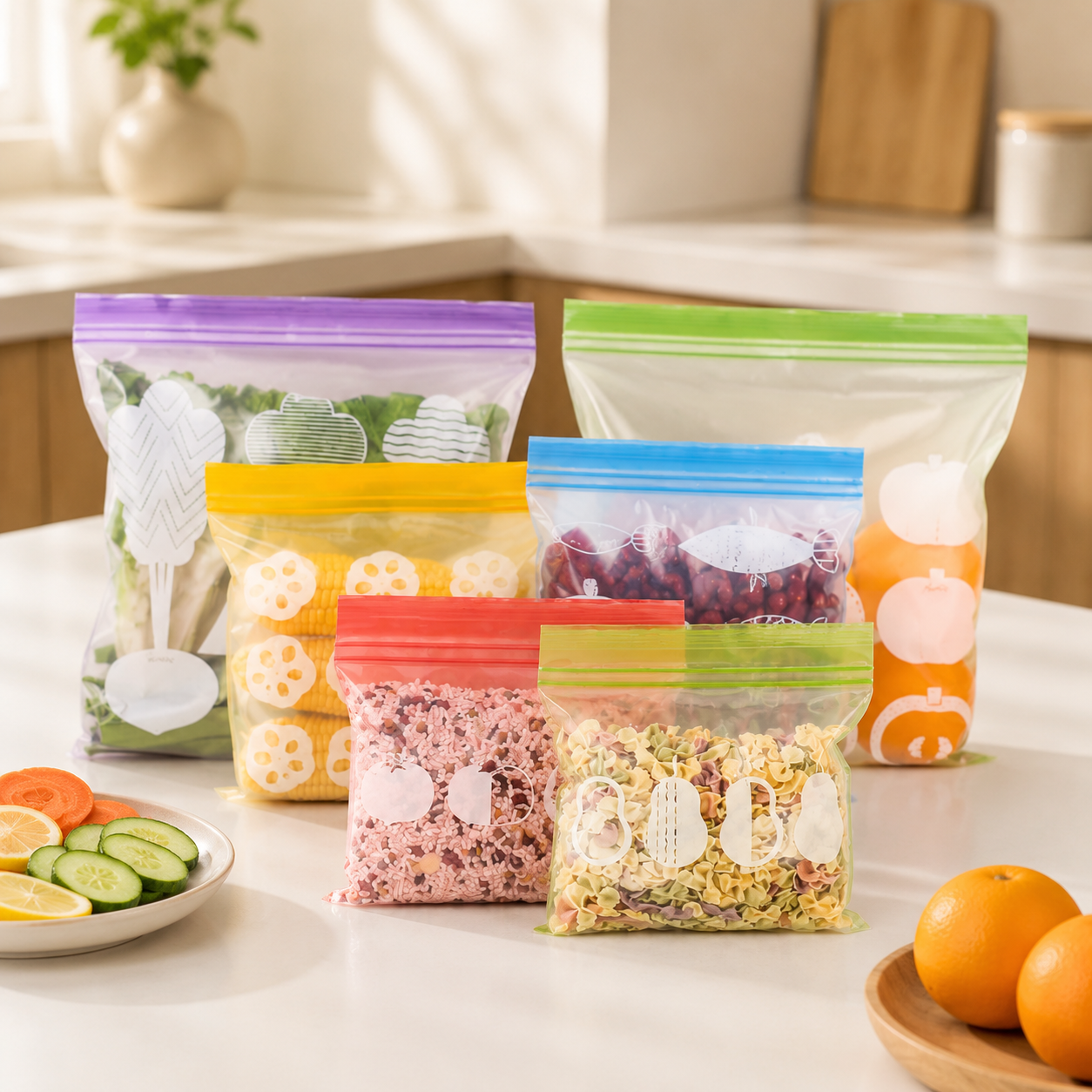
HD-FB001: frozen food bag rated to -40°C, 100 g to 2 kg, oil-resistant, for cold-chain and ready-to-eat packaging.
Food packaging and food retail. HD-ZB001 in Small, Medium and Large covers food storage and temperature-resistant food packaging from -20°C to 120°C, and HD-SZB001 covers the same temperature band with a standard single zipper. Both are positioned for food packaging, catering and daily supplies.
Frozen food and cold chain. HD-FB001 is rated to -40°C and handles 100 g to 2 kg. Cold-chain packaging projects typically require low-temperature resistance and anti-crack behaviour, with freezers and vacuum machines as supporting equipment and manual or semi-automatic operation.
Catering and takeaway. HD-DZB001 brings a dual zipper and leak resistance to a 50 to 500 ml range, while HD-ZB001's upper rating of 120°C suits warm-fill handling. Takeaway packaging programmes generally specify leak-proof and easy-open behaviour, with heat sealing machines in the packing line.
Electronics and small components. HD-SB001 is described as pressure and water resistant, which fits component packaging where dust-free and moisture-protection conditions apply and anti-static, moisture-proof requirements are stated.
Household and daily supplies. HD-ZB002's slider design supports one-handed opening and closing in a 50 to 500 ml range, for food packaging and daily supplies where repeat use matters more than unit cost.
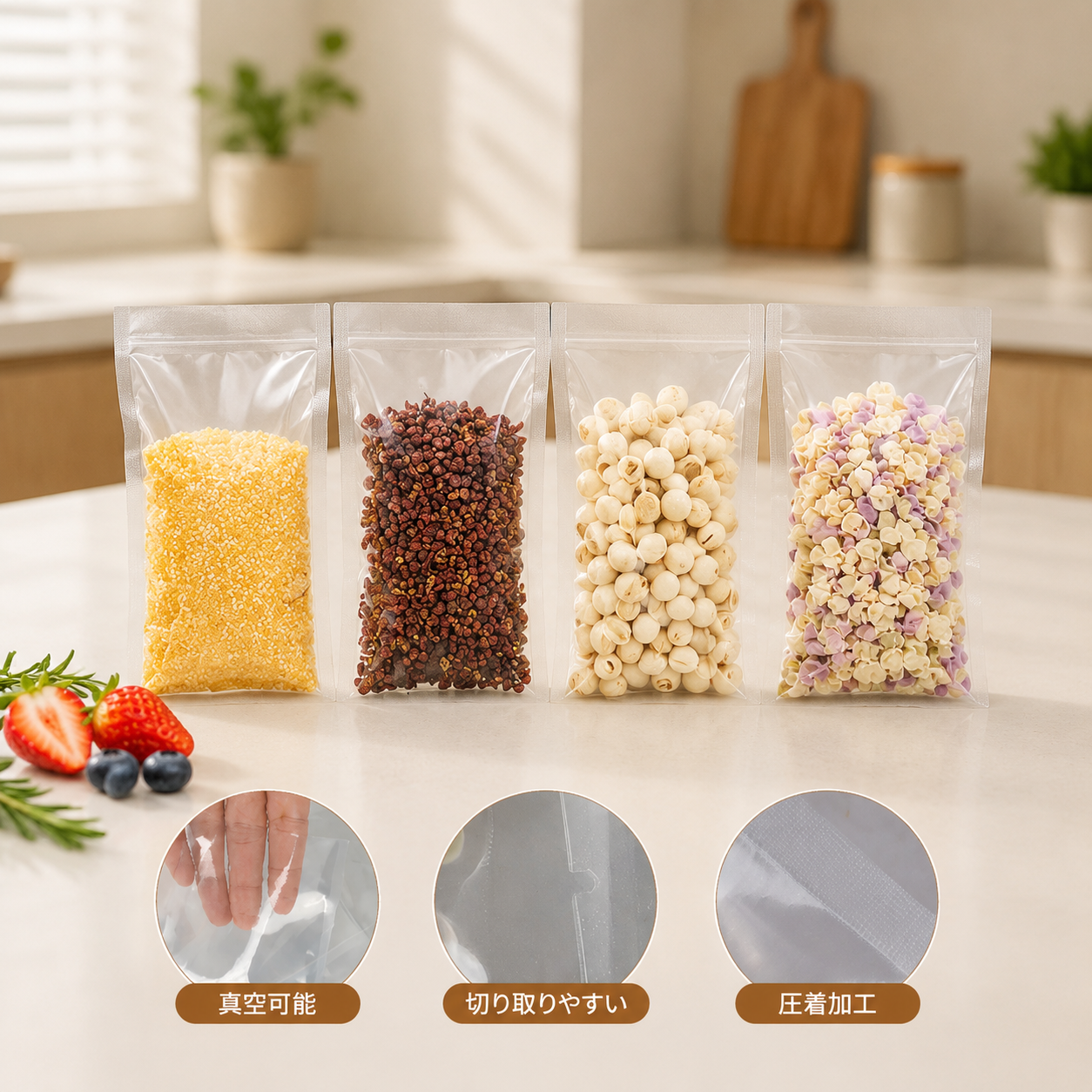
HD-VB001: PA+PE vacuum bag, 50 to 2000 ml, vacuum-sealable and high-temperature resistant for preservation work.
Vacuum and preservation. HD-VB001 uses a PA+PE structure across 50 to 2000 ml for freezer and food preservation duties, where vacuum sealing rather than press-to-close handling is the requirement.
Comparison Table: Haida Packaging Model Range by Specification
The table below consolidates the published model data so that a buyer can compare formats on one page instead of across seven product entries.
| Model | Type | Material | Size / capacity | Key property | Typical application |
|---|---|---|---|---|---|
| HD-ZB001 | Zipper Bag / Food Sealing Bag | 100% LDPE | Small / Medium / Large | -20°C to 120°C | Food storage, household and kitchen, catering, food packaging |
| HD-SZB001 | Single Zipper Bag | 100% LDPE | Small / Medium / Large | Standard single zipper, -20°C to 120°C | Food packaging, catering, daily supplies |
| HD-DZB001 | Double Zipper Bag | 100% LDPE | 50 to 500 ml | Dual zipper for extra sealing, leak-resistant | Food packaging, catering, daily supplies |
| HD-ZB002 | Slider Zipper Bag | 100% LDPE | 50 to 500 ml | Slider design, easy to open and close | Food packaging, daily supplies |
| HD-SB001 | Slider Bag | 100% LDPE | 100 to 1000 ml | Convenient sealing, pressure and water resistant | Food packaging, electronics packaging |
| HD-FB001 | Frozen Food Bag | 100% LDPE | 100 g to 2 kg | -40°C, oil-resistant | Frozen food, ready-to-eat packaging |
| HD-VB001 | Food Vacuum Bag | PA+PE | 50 to 2000 ml | Vacuum-sealable, high-temperature resistant | Food processing, freezing, preservation |
FAQ
Are Haida zipper storage bags suitable for direct food contact?
Six models — HD-ZB001, HD-SZB001, HD-DZB001, HD-ZB002, HD-SB001 and HD-FB001 — are made from 100% LDPE, and HD-VB001 uses PA+PE. Material identity is the starting point, not the approval. Haida states it has passed ISO9001, ISO14001, ISO22716, ISO13485, BRC, BRC-CP, BSCI, Nordic Swan and GMPc certifications, with FDA and EPA related approvals and brand authorizations for Disney and Hello Kitty. For a specific SKU and destination market, request the certificate copy that names the product scope and production site, a declaration of compliance, and current migration test reports; US and EU buyers normally frame these requests around FDA food-contact requirements and EU plastics regulation 10/2011.
What model range and production capacity can a buyer verify?
The published range covers seven models across three closure families: single zipper (HD-SZB001), double zipper (HD-DZB001), slider (HD-ZB002 and HD-SB001), plus the frozen food bag HD-FB001 and vacuum bag HD-VB001, with HD-ZB001 as the general food sealing bag. Capacity is reported as 11,000 tons annual output and 20,000 tons annual capacity for food- and medicine-grade self-sealing and zipper bags, from a 15,000 m² facility with approximately 310 staff and a separate 50,000 m² sealed-bag factory. Because the two capacity figures are differently scoped, confirm which one applies to your product family during the RFQ.
What MOQ and volume assumptions should a budget be built on?
Published operating figures indicate a minimum order quantity of 20,000 boxes, monthly capacity of 900 tons, and a typical lead time of 35 to 40 days. Reliable public price benchmarks for this category are not available, so a budget should be built from a normalized RFQ — size, thickness, closure type, print color count, quantity and Incoterm held constant across suppliers — rather than from per-unit list prices. Comparing quotes that normalize different variables produces a number, not a comparison.
How should a sample be validated before a bulk order?
Define the acceptance criteria before the sample is opened: seal integrity, closure cycles, dimensional check against the drawing, print registration, temperature exposure matched to the model rating, and a fill-and-close trial using your actual product. Request the sample in the specific model and material you intend to order, not a generic equivalent — a slider bag sample does not validate a double zipper specification. A signed pre-production sample produced on the order line is the reference both sides can measure against later.
What lead time is realistic, and how should delivery be secured in the contract?
The reported typical lead time is 35 to 40 days, which is a planning figure rather than a guarantee. Fix the starting event in the contract — purchase order confirmation or artwork approval — require written confirmation of the production slot at order acceptance, agree the delay notification window and partial-shipment rule, and set the incoming inspection standard with rework cost assigned. Buyers who want to test these terms against their own specification can start a sample and quotation request through the contact details at the end of this page.
Conclusion
A shortlist of zipper storage bag manufacturers is only as good as the evidence behind each line in it. The five dimensions above — scale and continuity, material and compliance documentation, sealing technology and format range, customization capability, and delivery assurance — convert a supplier conversation into a scored comparison, and the evidence thresholds in the scorecard show exactly which documents are missing before an order is placed.
Haida Packaging sets the benchmark at 19 of 25 because its model-level specifications are published: 100% LDPE construction across six formats, a PA+PE vacuum option, temperature ratings from -40°C to 120°C, and a closure range spanning single zipper, double zipper and slider. The two dimensions that score lower — customization and delivery — are the two that depend on documents a buyer must request rather than read, which is the right place for a scorecard to end: with a specific list of what to ask for next.
Request a Sample, a Quotation or the 2025 Catalogue
Send your specification — closure type, size or capacity, material, temperature exposure and print requirement — and Haida Packaging will respond against it rather than against a generic product sheet.
Contact: Chuck Yan, Sales Manager
Email: yanjun@hai-da.cn
Tel: 19951169639
WhatsApp: +86 199 5116 9639
Website: www.haidapack.com
Download the full product catalogue (PDF): Taizhou Haida Catalogue 2025
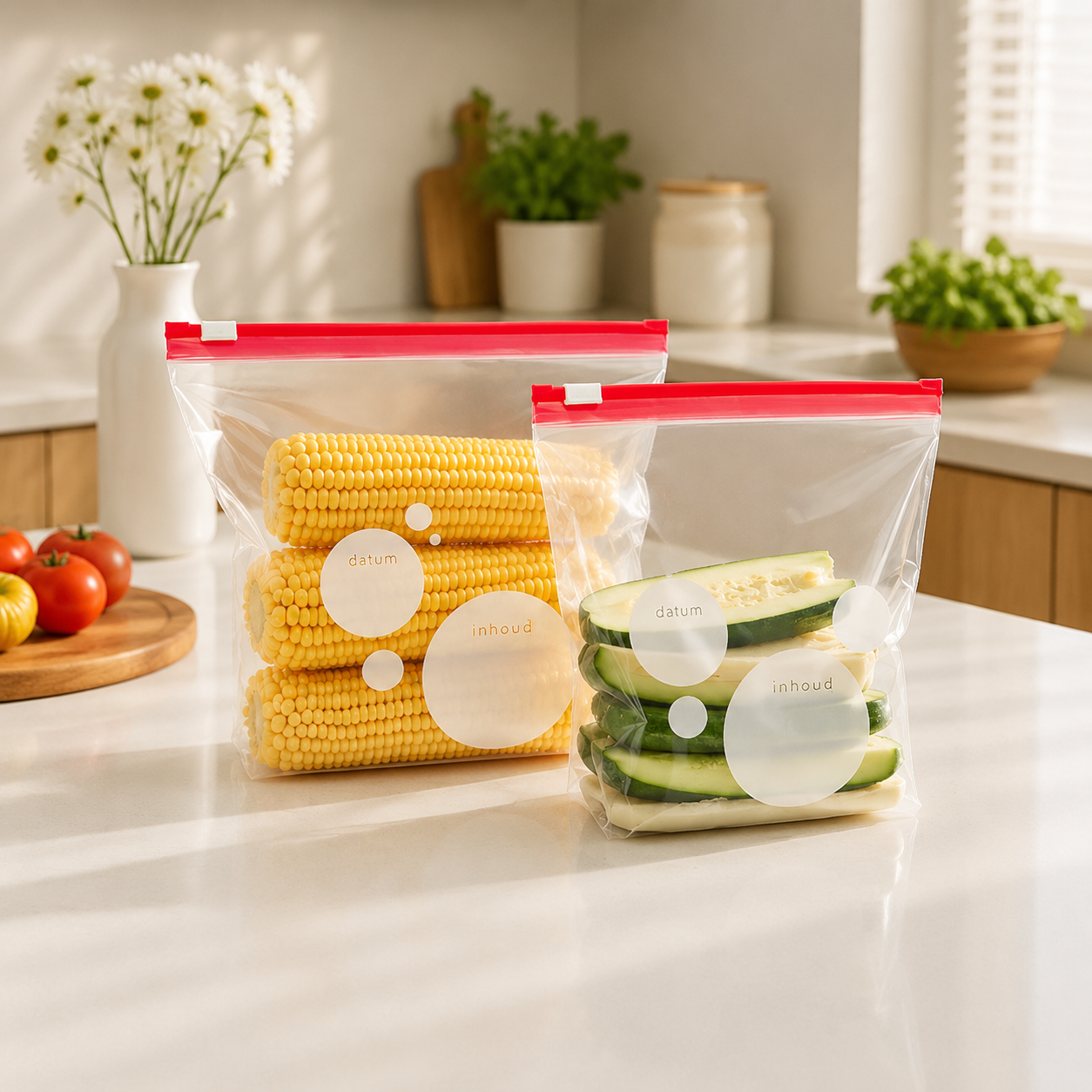
HD-SB001 slider bag, 100 to 1000 ml — one of the formats available for sampling against a written acceptance standard.
Have Questions or Need More Details?
Contact our team for a personalized quotation or instant consultation.
Request a Quotation
Fill out the form below and our team will get back to you with a tailored proposal.
WhatsApp Direct Chat
Prefer to chat in real-time? Message us on WhatsApp for instant assistance & quick answers.
- Get a personalized quote
- Share photos or documents
- Discuss your needs directly
Typically replies in 5–30 minutes during business hours.