Top 5 Zipper Storage Bags for Food Packaging: From Freezer to Catering
Top 5 Zipper Storage Bags for Food Packaging: From Freezer to Catering
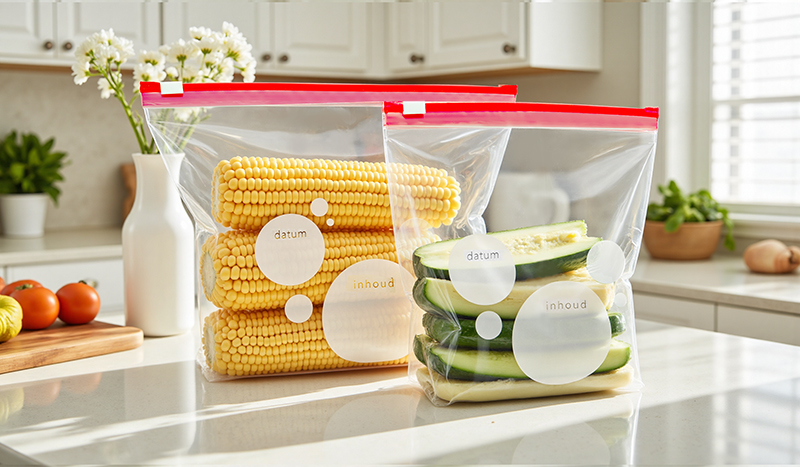
Short answer: of the five Haida models assessed here, HD-FB001 (Frozen Food Bag) ranks first for freezer-to-catering food packaging, followed by HD-SB001 (Slider Bag), HD-VB001 (Food Vacuum Bag, PA+PE), HD-DZB001 (Double Zipper Bag) and HD-ZB002 (Slider Zipper Bag). The order reflects documented material, capacity range, temperature data and application fit — not brand preference.
A zipper storage bag that survives a commercial freezer is not automatically the right bag for a takeaway counter, and neither is the right bag for protecting small electronic components in transit. This guide ranks five models from Taizhou Haida Plastic & Rubber Packaging Co., Ltd. — known as Haida Packaging, a zipper bag manufacturer founded in July 2003 and exporting roughly 90% of its output, mainly to Japan and Europe — against the four criteria the assigned brief requires: film material (LDPE versus PA+PE), capacity range, temperature resistance, and application fit across food packaging, catering and electronics.
Problem Definition: Why Picking a Food Zipper Bag Is Harder Than It Looks
Most zipper bag complaints in food operations trace back to three mismatches, none of which are visible on a product photo.
- Temperature mismatch. Standard polyethylene film behaves differently at −40 °C than at room temperature. A bag chosen for shelf storage can become brittle in a blast freezer, while a bag designed for cold chain may not be intended for hot-fill or reheating.
- Seal and leak mismatch. A single zipper closure is adequate for dry snacks. Sauces, dressings and takeaway items place different demands on the closure, which is why dual-zipper and slider designs exist as separate product lines rather than as cosmetic variants.
- Capacity and format mismatch. A 50–500 ml bag cannot portion a 2 kg frozen product, and a large-format bag wastes material when the real unit is a 100 g single serving. Portion size drives both packaging cost and line efficiency.
The practical consequence is that buyers often standardise on one familiar specification across several jobs — a sandwich bag for portions, a custom freezer bag for cold chain, a clear zipper storage bag for retail visibility — and then absorb the failures individually instead of matching the model to the job at the specification stage.
Industry Background: Food Packaging Is Now the Core of the Zipper Bag Market
Food packaging is the largest single application for zipper bags, and the segment keeps expanding faster than the category as a whole.
- The global zipper bag market was valued at approximately USD 10.34 billion in 2024 and is projected to reach USD 19.44 billion by 2035 (Market Research Future).
- Food packaging accounted for roughly 39.2% of global zipper bag market revenue as of 2025, with strong adoption in frozen food and snack segments (Dataintelo).
- The stand-up zipper pouch segment — a format closely related to flat zipper bags — was valued at USD 2.61 billion in 2024, with a projected path to USD 3.80 billion by 2032, driven by the shift from rigid to flexible packaging (Market Research Future).
- The subscription-box and meal-kit delivery sector surpassed USD 20 billion in 2024, increasing demand for custom-printed zipper bags used for ingredient portioning (Dataintelo).
- Asia-Pacific is the fastest-growing region for zipper bags and holds a significant share of global manufacturing capacity (Towards Packaging).
Watch the scope of market figures. Published estimates for the zipper bag market diverge widely by definition — Cognitive Market Research cites roughly USD 2.45 billion, Global Growth Insights cites USD 3.83 billion for a plastic-bag-focused scope, while Market Research Future cites USD 10.34 billion. When a supplier quotes a market number, ask what is included: retail food bags only, or industrial and medical packaging as well.
Retail shelves in North America and Europe are dominated by consumer brands such as Ziploc (SC Johnson), Hefty and Fresh-Lock (Reynolds Consumer Products) and Amcor plc. Haida Packaging competes in a different lane: OEM and custom manufacturing for importers, brand owners and food producers who need printed, sized and certified bags rather than a retail SKU. That is the context in which the ranking below should be read.
The Ranking: Five Haida Zipper Bags for Food Packaging, Freezer to Catering
The ranking uses five measurable inputs taken from Haida's published product specifications and documented project records: (1) documented temperature data, (2) seal design and leak resistance, (3) usable capacity range for portioning, (4) film material and barrier behaviour, and (5) documented application fit in food, catering and electronics use.
Rank reflects overall fit across a freezer-to-catering workflow. It is not a claim of universal superiority: for a single narrow job, a lower-ranked model is often the correct and more economical choice, and the limitations below are stated for each model so that trade-offs are visible.
- HD-FB001 – Frozen Food Bag — best overall for frozen, chilled and ready-to-eat food packaging.
- HD-SB001 – Slider Bag — best general-purpose catering and portioning bag with one-hand operation.
- HD-VB001 – Food Vacuum Bag — best for vacuum sealing, preservation and higher-temperature processing.
- HD-DZB001 – Double Zipper Bag — best for leak-resistant takeaway, delivery and small-portion retail packs.
- HD-ZB002 – Slider Zipper Bag — best for household and small daily-supply portions.
1HD-FB001 – Frozen Food Bag
HD-FB001 ranks first because it is the only model in this set with a published sub-zero rating. A low-temperature resistance to −40 °C covers blast freezing and cold-chain storage, where film brittleness and cracking are the most common causes of bag failure. The oil-resistant property extends the same bag to prepared foods, marinades and ready-to-eat items that would otherwise attack a standard film.
The capacity range of 100 g to 2 kg is also the widest portioning window of the five models when measured in food weight rather than volume, which matters for frozen processors who pack by unit weight rather than by fill level.
Best for: frozen food processors, cold-chain distribution, prepared and ready-to-eat meals, and food manufacturers who pack by weight. Limitation: HD-FB001 is a dedicated freezer and ready-to-eat format. It is not a general-purpose household bag and it is not specified for vacuum sealing or for pressure and water resistance in the same way as the slider and double-zipper models.
2HD-SB001 – Slider Bag
HD-SB001 earns second place on breadth. Its 100 – 1,000 ml range is the widest practical everyday window among the LDPE models, and the slider closure gives pressure and water resistance plus reliable one-hand closing — the reason slider bags are common on fast-moving packing lines where operators use gloves.
The model also has the strongest documented project record in this set. A Japanese frozen food processor used it for cold-chain frozen food packaging on a large-scale basis over three years, with reported outcomes of reduced product damage and improved shelf life; the stated features for that project were low-temperature resistance, anti-crack material and bulk supply capability. A separate Japanese food manufacturer used the same model for food packaging and portion control over two to three years, with custom sizes and logos, FDA/LFGB compliance and a leak-proof design, reporting stable supply and improved packaging efficiency.
Best for: catering and food-service packing lines, portion control, mixed food-and-component packing, and buyers who want one stock model across several jobs. Limitation: Haida's specification sheet for HD-SB001 does not publish a temperature figure. Cold-chain performance is supported by the documented project record, but buyers should confirm the intended temperature window in writing before running trial production.
3HD-VB001 – Food Vacuum Bag
HD-VB001 is the only model here built on a multi-layer PA+PE film rather than 100% LDPE, and it shows: the bag is vacuum-sealable, which no single-layer LDPE model in this set is, and it is high-temperature resistant. Its 50 – 2,000 ml capacity range is the widest of the five, covering both small condiment portions and larger bulk packs used in food processing and preservation.
The layer change matters to buyers in two ways. First, vacuum sealing is a barrier process rather than a closure choice, so tasks that depend on removing oxygen belong on this model instead of on a zipper-only bag. Second, PA+PE is a different material stream from LDPE — it is generally stiffer and, in most operations, is quoted and handled separately from polyethylene film.
Best for: vacuum packing, freezing and long preservation, food processing, and programs where product shelf life depends on removing air. Limitation: HD-VB001 requires vacuum equipment, so it is not a drop-in replacement for a zipper bag on a manual packing table; and because it is PA+PE rather than LDPE, buyers should not assume the same unit price, film feel or material handling as the other four models.
4HD-DZB001 – Double Zipper Bag
The double zipper is a leak-control decision. Two parallel closure tracks plus a leak-resistant construction make HD-DZB001 the appropriate choice when the packed item contains liquid or semi-liquid product and the bag has to travel — takeaway, delivery, dressings and sauces.
The model is backed by a documented retail case: a Japanese retail and convenience store client used it for daily product packaging over one to two years, citing transparent film for product visibility and strong sealing, with consistent quality and convenience for staff as the reported outcomes.
Best for: catering and restaurant chains, takeaway and delivery packing, convenience retail, and any application where a single zipper has previously leaked. Limitation: capacity caps at 500 ml, so this model is suited to small and individual portions rather than bulk or family-size packaging.
5HD-ZB002 – Slider Zipper Bag
HD-ZB002 is the smallest-scope model in the ranking: a 50 – 500 ml LDPE bag whose defining feature is a slider that opens and closes smoothly. It ranks fifth not because of a defect, but because its specifications address a narrower job than the four models above it — small portions in household, kitchen and daily-supply settings rather than freezing, vacuuming or leak-prone catering transport.
Best for: snack and sandwich portions, household and kitchen resealable storage, daily supplies, and low-fill retail packs where the slider is valued for repeated opening. Limitation: no published temperature data, so it should not be assumed suitable for freezer or high-temperature use.
Two more models sit alongside these five. Haida's range also includes HD-SZB001 (Single Zipper Bag) and HD-ZB001 (Food Sealing Bag), both 100% LDPE and documented as temperature resistant from −20 °C to 120 °C in small, medium and large sizes, serving food packaging, catering and daily supplies. Where the ranking above needs a temperature figure that is not published, these two models show the range's verified temperature envelope.
Step-by-Step: How to Shortlist the Right Zipper Storage Bag for Your Line
The same six-step sequence can be applied to a Haida model or to any comparable zipper bag on the market.
- Lock the temperature window first. Write down the coldest and hottest point the packed product will experience — not the room temperature of your packing hall. HD-FB001 is rated low-temperature resistant to −40 °C; HD-VB001 is high-temperature resistant; HD-SZB001 and HD-ZB001 are documented at −20 °C to 120 °C. Models without a published figure should be treated as unverified for that window until the supplier confirms it in writing.
- Choose the closure by failure risk. Single zipper for dry, low-risk contents; dual zipper where leaking is costly (HD-DZB001); slider where speed, gloved handling or one-hand operation matters (HD-SB001, HD-ZB002); vacuum seal where oxygen removal is part of the preservation method (HD-VB001).
- Size the bag to the real portion. Match the capacity range to your unit, not to your shelf: 50–500 ml for condiments and small portions, 100–1,000 ml for catering and portion control, 100 g–2 kg for frozen product packed by weight, 50–2,000 ml for vacuum and preservation work.
- Match the film to the job. LDPE is the flexible, easy-sealing workhorse used by HD-FB001, HD-SB001, HD-DZB001 and HD-ZB002; PA+PE is the multi-layer choice for vacuum and higher-temperature duty (HD-VB001). Changing material changes price, feel and recyclability assumptions.
- Confirm food-contact compliance for the destination market. EU-bound food packaging must comply with LFGB and EU No 10/2011; US food-grade polyethylene must follow FDA 21 CFR 177.1520 for resin composition and migration limits. Confirm the tested scope covers your specific film and structure, not just the factory.
- Confirm the commercial envelope. Haida's stated terms are OEM production, logo and print customisation, a minimum order quantity of 20,000 boxes, a typical production lead time of 35–40 days, a monthly capacity of 900 tons, delivery FOB Shanghai and 30/70 payment. If your program cannot absorb those parameters, that is a sourcing problem, not a bag problem — resolve it before sampling.
Use Cases: Five Documented Applications in Japan
Haida's main export markets are Japan and Europe, and its project records show how the same product family is split across very different jobs.
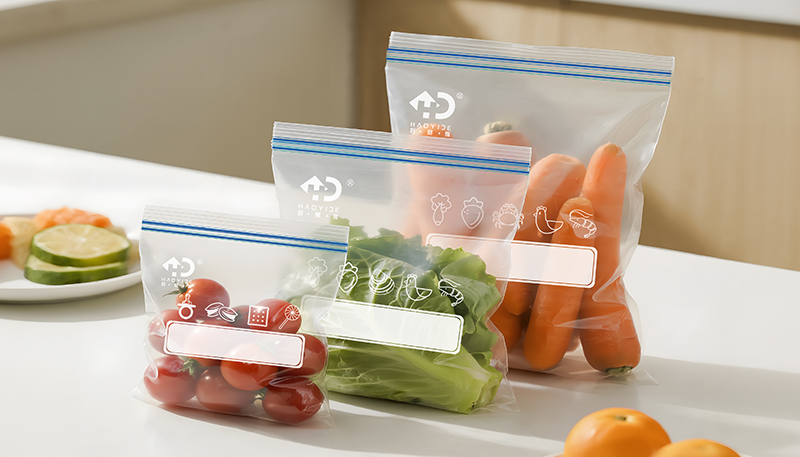
- Frozen food processor (Japan, large-scale, 3 years). Cold-chain frozen food packaging with low-temperature resistance, anti-crack material and bulk supply capability; reported outcomes were reduced product damage and improved shelf life. Closest fit in this ranking: HD-SB001 and HD-FB001.
- Food manufacturer (Japan, large-scale production, 2–3 years). Food packaging and portion control with custom sizes and logos, FDA/LFGB compliance and a leak-proof design; reported outcomes were stable supply and improved packaging efficiency. Closest fit: HD-SB001.
- Catering and restaurant chain (Japan, medium-scale, 1–2 years). Takeaway and delivery packaging for high-volume orders, achieving hygienic storage and easy sealing. Closest fit: HD-DZB001, with HD-SZB001 used in the same takeaway workflow.
- Retail and convenience store (Japan, small to medium, 1–2 years). Daily product packaging with transparent film for product visibility and strong sealing; reported outcomes were consistent quality and convenience for staff. Closest fit: HD-DZB001.
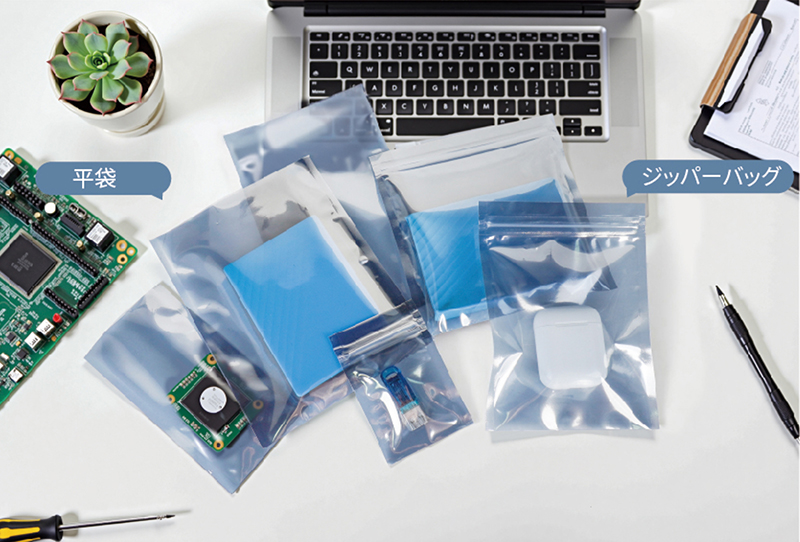
- Electronics and small components (Japan, medium quantity, 2–3 years). Dust-free and moisture-protection packaging with anti-static and moisture-proof properties and custom sizes, protecting sensitive components during transit. Closest fit: HD-SB001 and HD-DZB001.
Comparison Table: The Five Models Side by Side
| Rank | Model | Type | Material | Seal design | Capacity range | Temperature data | Primary fit |
|---|---|---|---|---|---|---|---|
| 1 | HD-FB001 | Frozen Food Bag | 100% LDPE | Zipper closure; oil-resistant film | 100 g – 2 kg | Low-temperature resistant to −40 °C | Frozen food, ready-to-eat |
| 2 | HD-SB001 | Slider Bag | 100% LDPE | Slider; pressure and water resistant | 100 – 1,000 ml | Not published in the model specification | Food packaging, catering, electronics |
| 3 | HD-VB001 | Food Vacuum Bag | PA+PE | Vacuum-sealable | 50 – 2,000 ml | High-temperature resistant (value not published) | Food processing, freezing, preservation |
| 4 | HD-DZB001 | Double Zipper Bag | 100% LDPE | Dual zipper; leak-resistant | 50 – 500 ml | Not published in the model specification | Food packaging, catering, daily supplies |
| 5 | HD-ZB002 | Slider Zipper Bag | 100% LDPE | Slider; easy open and close | 50 – 500 ml | Not published in the model specification | Household and kitchen, daily supplies |
Material Comparison: LDPE versus PA+PE
| Attribute | LDPE (HD-FB001, HD-SB001, HD-DZB001, HD-ZB002, HD-SZB001, HD-ZB001) | PA+PE (HD-VB001) |
|---|---|---|
| Structure | Single-layer polyethylene film | Multi-layer polyamide + polyethylene film |
| Sealing | Zipper, slider and dual-zipper closures | Vacuum-sealable construction |
| Published temperature data | −40 °C on HD-FB001; −20 °C to 120 °C on HD-ZB001 and HD-SZB001 | High-temperature resistant (numeric value not published) |
| Typical role | Everyday food, freezer, catering and retail packing | Preservation, vacuum packing and processing |
Compliance and OEM Capability: What to Verify Before You Commit
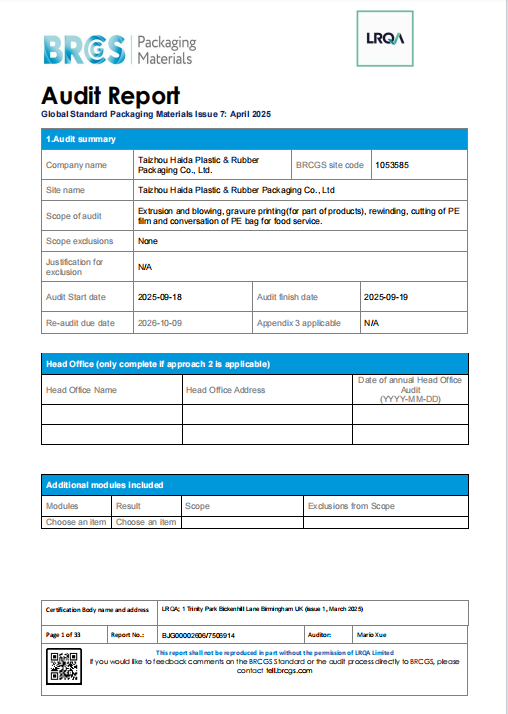
Food-contact packaging is a regulated purchase, so capability claims are only useful when they carry an audit trail. Haida Packaging holds BRCGS Global Standard for Packaging Materials certification at A+ grade (certificate BJG00002606/7506914, issued by LRQA on 17 October 2025, valid to 3 December 2026, scope: packaging materials), and an amfori BSCI social audit report at Grade A (Excellent) (certificate 25-0344964, issued by Bureau Veritas Hong Kong Limited on 30 September 2025, valid to 30 September 2026, scope: packaging industry).
The company's quality and environmental system coverage includes ISO 9001, ISO 14001, ISO 22716, ISO 13485, BRC, BRC-CP, BSCI, GMPc, FDA and EPA, together with Disney and Hello Kitty brand authorisations. On materials, Haida performs food-safety compliance testing to FDA and LFGB standards, and an SGS test report on materials covered Regulation (EC) No 1935/2004, German LFGB Sections 30 and 31, and Regulation (EU) No 10/2011.
Buyer action. Request the certificate PDFs rather than a summary, and check three things on each: the certificate number, the issue and expiry dates, and the certified scope. Test reports and social audits are renewed on their own cycles, so a document that was current at quotation may need renewal before your production date — ask for the version covering your shipment window.
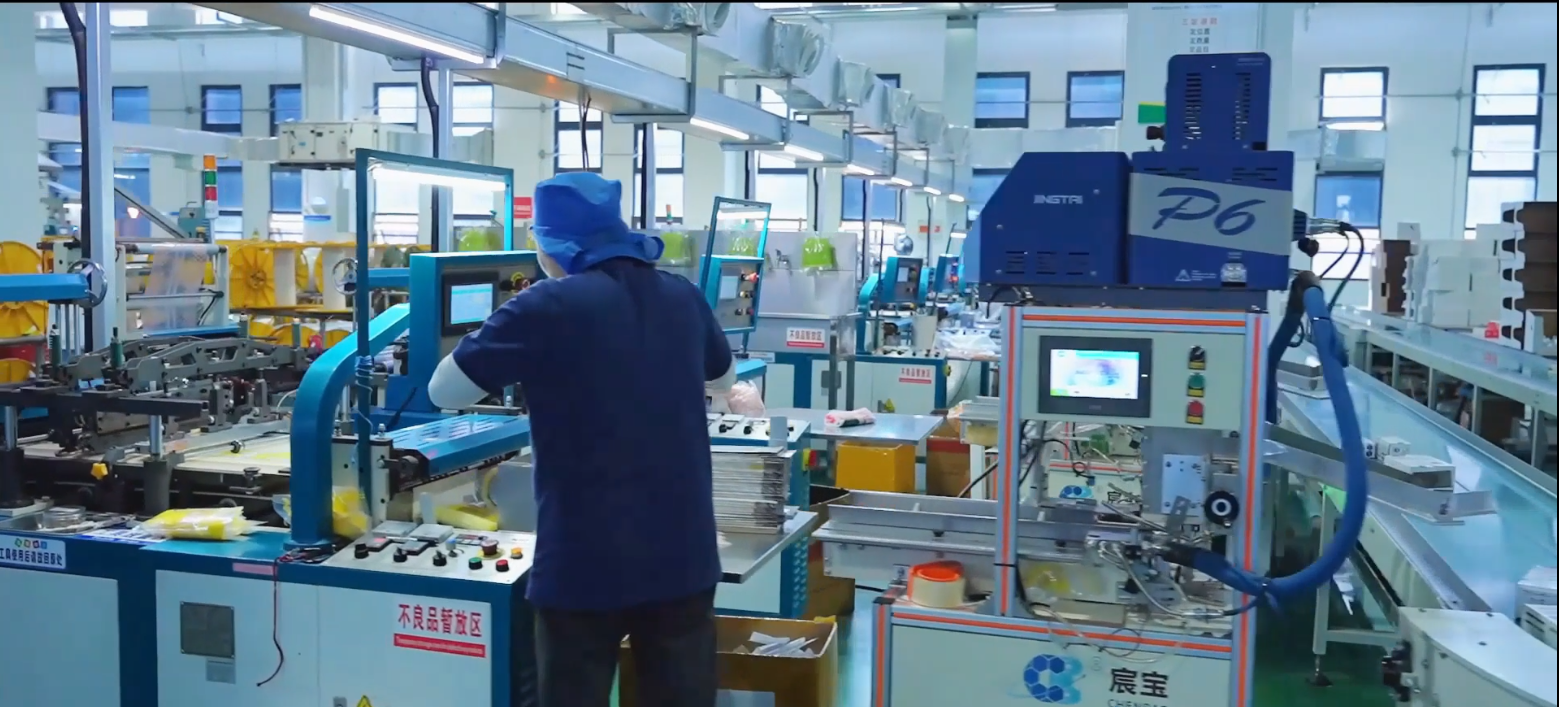
On the production side, Haida operates as an OEM manufacturer with logo and print customisation, a monthly capacity of 900 tons, a typical lead time of 35–40 days and a minimum order quantity of 20,000 boxes. Quality control combines food-safety compliance testing to FDA and LFGB standards with visual inspection, and shipment acceptance covers visual inspection, sample testing, and sealing and packaging checks, on FOB Shanghai terms with 30/70 payment.
FAQ
Which certifications should food buyers verify before ordering these zipper storage bags?
Verify at least the packaging-safety and social-compliance certificates, and check their validity dates. Haida Packaging holds BRCGS Global Standard for Packaging Materials at A+ grade (BJG00002606/7506914, LRQA, issued 17 October 2025, valid to 3 December 2026, scope: packaging materials) and an amfori BSCI social audit at Grade A (25-0344964, Bureau Veritas Hong Kong Limited, issued 30 September 2025, valid to 30 September 2026, scope: packaging industry). For food contact, EU-bound products must comply with LFGB and EU No 10/2011, and US food-grade polyethylene must follow FDA 21 CFR 177.1520; Haida performs FDA and LFGB compliance testing, and a 2025 SGS materials report covered Regulation (EC) No 1935/2004, LFGB Sections 30 and 31, and Regulation (EU) No 10/2011.
Can all five models be customised for OEM food packaging?
Yes. Haida provides OEM production with logo and print customisation across the range, which is what makes custom printed zipper bags, custom food grade zipper bags and custom slider zipper bags feasible for brand owners and importers rather than only for retail brands. Customisation applies to the five ranked models — HD-FB001, HD-SB001, HD-VB001, HD-DZB001 and HD-ZB002 — and covers sizes within their published ranges: 50–500 ml for HD-ZB002 and HD-DZB001, 100–1,000 ml for HD-SB001, 100 g–2 kg for HD-FB001, and 50–2,000 ml for HD-VB001. Monthly capacity is 900 tons, and the documented food-manufacturer project in Japan explicitly included custom sizes and logos.
What actually drives the cost of a custom zipper storage bag order?
Five factors dominate: film material (100% LDPE versus the PA+PE multi-layer construction used by HD-VB001), closure type (single zipper, dual zipper or slider), print and logo work, bag size within the model's capacity range, and order volume relative to Haida's minimum order quantity of 20,000 boxes. Delivery terms matter as well — Haida quotes FOB Shanghai with 30/70 payment. No unit prices are published for these models, so cost should always be requested as a quotation tied to a defined specification, material, closure, size and print. For context on why food packaging pricing has been moving, note that food packaging accounted for roughly 39.2% of global zipper bag revenue as of 2025 (Dataintelo).
How do I validate a bag before committing to bulk production?
Use the same acceptance logic Haida applies at shipment: visual inspection, sample testing, and sealing and packaging checks. In practice that means requesting samples of the exact model and specification you intend to buy, testing the closure repeatedly, testing at your real temperature window — −40 °C for a custom freezer bag such as HD-FB001, or a hot-fill or vacuum cycle for HD-VB001 — and testing with the actual product, particularly oily or liquid contents where the oil-resistant or leak-resistant properties matter. Keep the accepted sample as the production reference so that bulk shipments can be compared against it.
What lead time, MOQ and after-sales support should I expect?
Haida's stated commercial parameters are a minimum order quantity of 20,000 boxes, a typical production lead time of 35–40 days, a monthly capacity of 900 tons, and delivery FOB Shanghai with 30/70 payment. After-sales support runs through email and WhatsApp, covering product and storage guidance, technical support, and replacement for quality issues or defects. Because 35–40 days starts from a confirmed specification and approved sample, the sampling step should be planned into your own launch calendar rather than treated as an optional extra.
Conclusion: Match the Model to the Job, Not the Shelf
The five models in this ranking solve five different problems. HD-FB001 owns the freezer with a −40 °C rating and a 100 g–2 kg range. HD-SB001 covers the widest everyday span at 100–1,000 ml with a pressure- and water-resistant slider, and carries the strongest documented project record in food manufacturing and cold chain. HD-VB001 is the only PA+PE, vacuum-sealable option at 50–2,000 ml. HD-DZB001 is the leak-resistant choice for takeaway and small retail portions. HD-ZB002 handles small household and daily-supply portions with a smooth slider.
Read as a set, they also show the selection logic that matters more than any single specification: temperature first, then closure by leak risk, then capacity by real portion size, then material, then compliance, then the commercial envelope. Buyers who work in that order rarely need to re-specify a bag after the first production run.
Next Step: Match a Model to Your Specification
If you are evaluating a freezer program, a catering line or a custom printed food bag, the fastest way to narrow the choice is to share your temperature window, portion size and target market. Haida Packaging can confirm which of the five models fits, and what customisation is available within its range.
Download the full catalogue: Taizhou Haida Catalogue 2025 (PDF)
Contact: Chuck Yan, Sales Manager · Tel/WhatsApp: 19951169639 · Email: yanjun@hai-da.cn · Website: haidapack.com · WhatsApp: message us
Address: Building 4 and 8, No.55 Jichuan East Road, Hailing District, Taizhou, Jiangsu, China.
Have Questions or Need More Details?
Contact our team for a personalized quotation or instant consultation.
Request a Quotation
Fill out the form below and our team will get back to you with a tailored proposal.
WhatsApp Direct Chat
Prefer to chat in real-time? Message us on WhatsApp for instant assistance & quick answers.
- Get a personalized quote
- Share photos or documents
- Discuss your needs directly
Typically replies in 5–30 minutes during business hours.