Evaluating a Zipper Bag Supplier's Capability: Capacity, Materials, and Model Range
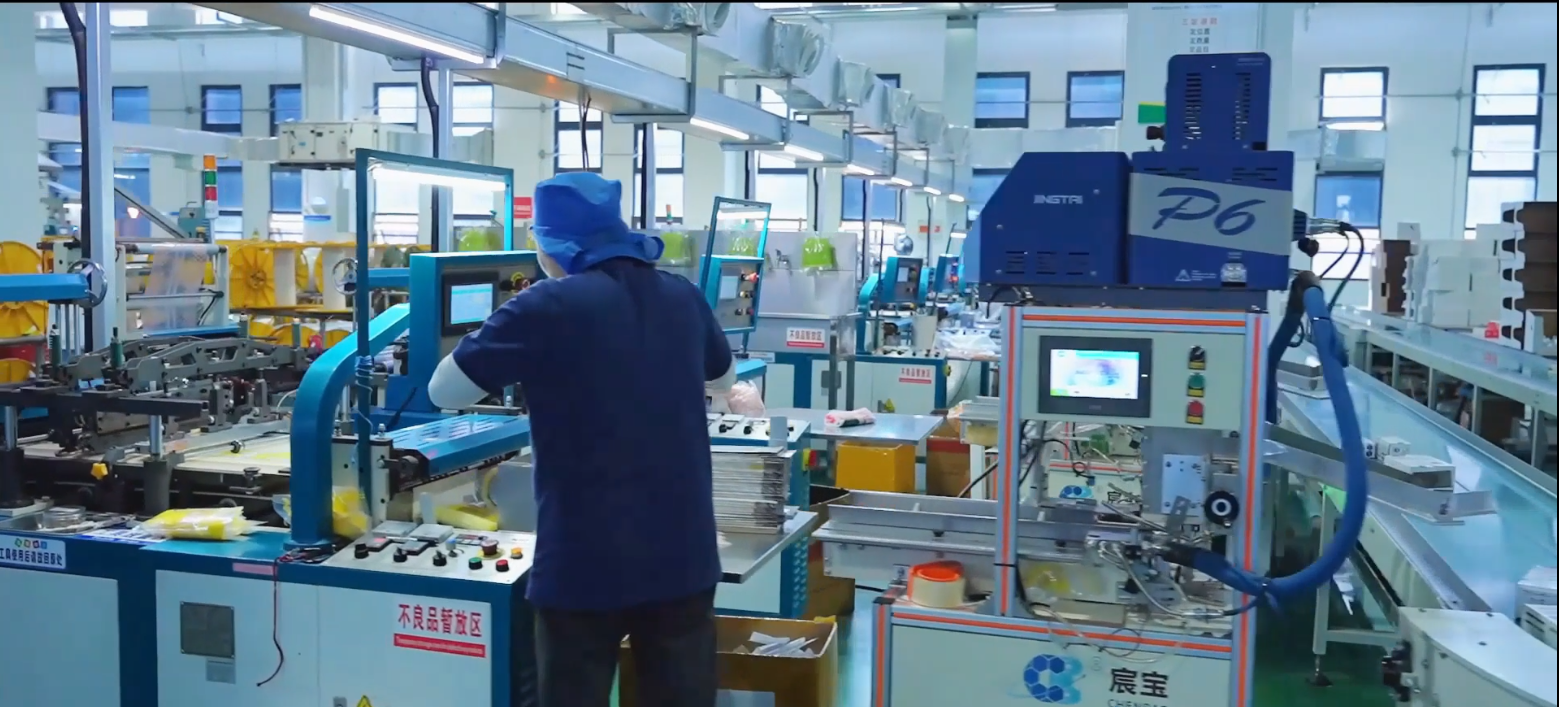
A zipper bag supplier's capability can be evaluated in three measurable layers: production capacity, the materials the factory actually runs, and the depth of its model range at specification level. A sample proves that one bag can be made; it does not prove that the same bag can be produced at hundreds of tons per month, in a documented food-grade material, at the temperature window and portion size your product requires.
This guide is written for the point where a packaging project moves from Evaluation into Execution — after the shortlist, before the purchase order. It sets out what to request, how to read model-level specifications (including weight-defined models such as the HD-FB001 frozen food bag, rated for 100 g to 2 kg portions), and how to separate capability evidence from capability claims. Haida Packaging, the brand of Taizhou Haida Plastic & Rubber Packaging Co., Ltd., a zipper bag manufacturer founded in 2003, is used throughout as a worked example, because its published records cover capacity, material testing and a seven-model range in enough detail to demonstrate the method.
Problem Definition: Capability Claims Are Not Capability Evidence
Almost every supplier conversation opens with a sentence that cannot be tested: 'we can produce any zipper bag you need.' The statement is rarely false. It is simply unverifiable, and unverifiable statements are a poor basis for a purchase order.
Capability evidence behaves differently. It has a number attached to it — a monthly tonnage, a temperature rating, a certificate number, a model code — and it can be checked by a third party. The distinction matters most in four situations that buyers meet repeatedly:
- Model drift. The approved sample exists as a hand-built reference, while the factory's standard tooling and film inventory cover a different size class. The buyer approves one specification and receives another.
- Material substitution. Two bags can look identical on a table and behave differently in a freezer. Without resin-level documentation, a buyer cannot tell a 100% LDPE bag rated to -20°C from one rated to -40°C.
- Capacity mismatch. A pilot of a few thousand units is easy to schedule. A programme requiring hundreds of tons per year is a question about monthly output, floor space, staffing and equipment — none of which appears in a product photo.
- Documentation gaps. Retail, catering and export customers increasingly require material test reports mapped to specific regulations. If the supplier's file does not already contain them, the buyer inherits the delay.
The practical conclusion is that supplier evaluation should be organised around three verifiable layers rather than around samples and price lists.
Industry Background: Why Capability Assessment Has Become a Procurement Discipline
Demand for reclosable flexible packaging keeps expanding, and with it the cost of choosing the wrong converter. Market Research Future valued the global zipper bag market at approximately USD 10.34 billion in 2024, with a projected path to USD 19.44 billion by 2035. Within that market, food packaging accounted for roughly 39.2% of revenue as of 2025, with notable adoption in frozen food and snack segments (Dataintelo). The stand-up zipper pouch segment alone was valued at USD 2.61 billion in 2024 and is expected to reach USD 3.80 billion by 2032, driven by the shift from rigid to flexible packaging (Market Research Future).
Two structural drivers sit behind those numbers. First, subscription-box and meal-kit delivery passed USD 20 billion in 2024, which increased demand for custom printed zipper bags used for ingredient portioning (Dataintelo). Second, Asia-Pacific is the fastest-growing region for zipper bags and holds a significant share of global manufacturing capacity (Towards Packaging) — which is why supplier assessment for many buyers now means assessing an Asian converting partner.
The supply side is also partly shaped by large consumer brands. In the reclosable zipper packaging space, SC Johnson (Ziploc), Reynolds Consumer Products (Hefty / Fresh-Lock) and Amcor plc are established global names. For private-label, food-service and industrial buyers, this means competing for converting capacity with well-capitalised players, and it makes documented capability — not scale alone — the practical differentiator.
Regulation adds a second filter. Zipper bags intended for food contact in the European Union must comply with LFGB and Regulation (EU) No 10/2011, and major retailers treat BRCGS and amfori BSCI certification as entry barriers. In the United States, food-grade polyethylene bags are governed by FDA 21 CFR 177.1520 for resin composition and migration limits. A supplier whose capability file cannot map to these references will slow down every downstream approval.
A Three-Layer Framework for Assessing Zipper Bag Supplier Capability
The framework below converts general capability claims into three layers of checkable data: capacity, materials and model range. Each layer has its own evidence type, and each can be verified before a purchase order is issued.
Layer 1 — Production Capacity: Can the Volume Be Repeated?
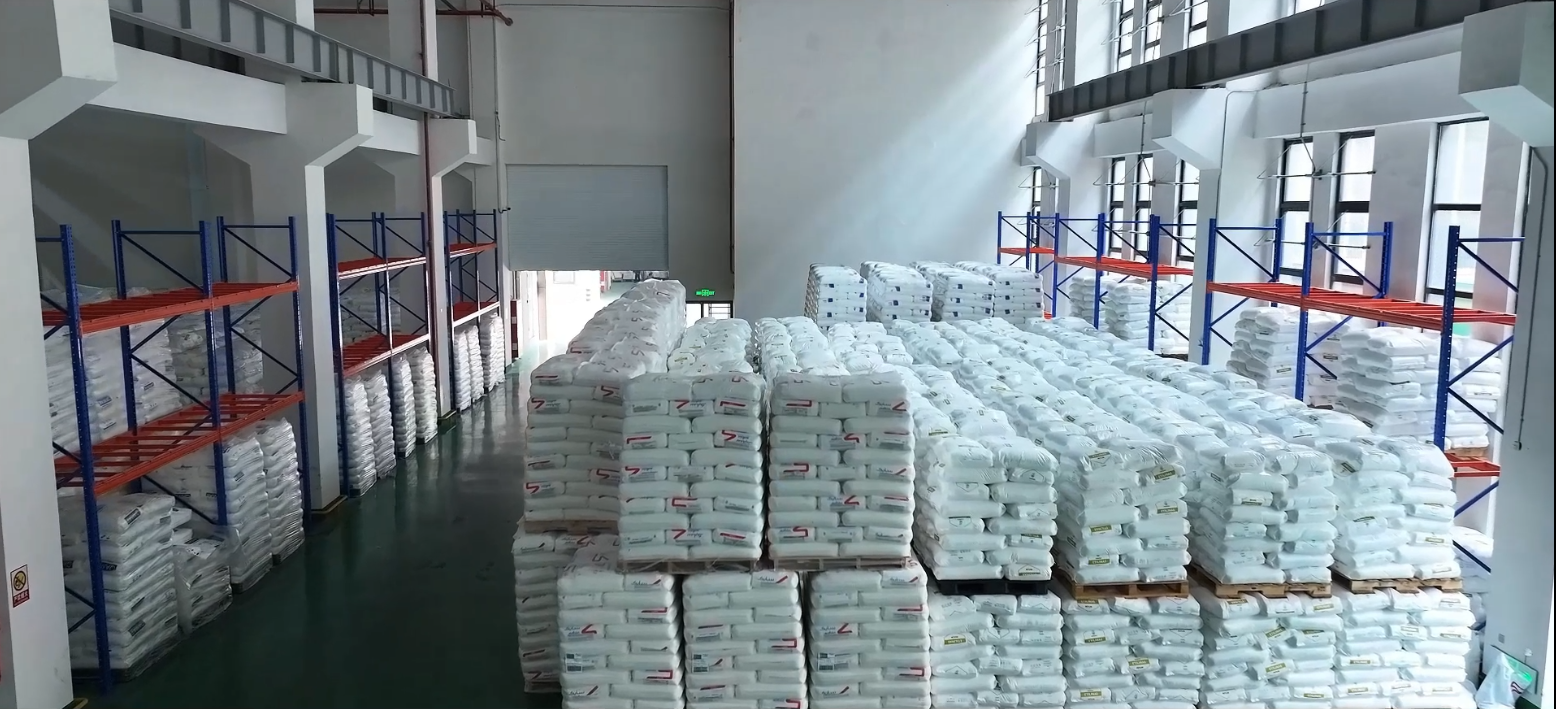
Capacity is the layer most often summarised in adjectives and least often supported by figures. The figures worth asking for are specific and few: monthly output, annual output, production area, workforce, in-house engineering headcount and export share.
For Haida Packaging, those data points are: a production site of 15,000 m², 310 employees, an annual output of 11,000 tons, and a monthly capacity of 900 tons. The company was founded in 2003, maintains an R&D team of 20 engineers, and exports approximately 90% of its output, primarily to Japan and Europe. Standard lead time is 35–40 days, and production is run in OEM mode.
Why each number matters:
- Monthly tonnage (900 tons). This is the ceiling against which your own annual demand is measured. A buyer planning 200 tons per year is using roughly 1.9% of monthly capacity — comfortable. A buyer planning 4,000 tons per year is not buying from a supplier, but negotiating a dedicated line.
- Annual output (11,000 tons) and site area (15,000 m²). Together they indicate that capacity is not rented or brokered; it sits on owned, staffed floor space.
- R&D headcount (20 engineers). Model additions, size changes and logo customisation require engineering time. A supplier without in-house engineering will resell your customisation to a third party.
- Export share (about 90%, mainly Japan and Europe). A high export ratio is indirect evidence that the supplier already operates under import-market requirements rather than learning them on your order.
- Lead time (35–40 days). This is the planning number for your replenishment cycle, and it should be confirmed in writing for peak periods.
Layer 2 — Materials: LDPE and PA+PE, and What the Ratings Actually Say
Material is where a supplier's capability file is either specific or vague. The relevant questions are simple: which polymer, which temperature window, which chemical resistance, and which test report supports the claim.
Across the Haida range, two material families are used. Six models are produced in 100% LDPE — the HD-ZB001 food sealing bag and the HD-SZB001 single zipper bag (both rated -20°C to 120°C), the HD-DZB001 double zipper bag, the HD-ZB002 slider zipper bag, the HD-SB001 slider bag (described as pressure and water resistant), and the HD-FB001 frozen food bag (low-temperature resistant to -40°C and oil-resistant). The seventh model, the HD-VB001 food vacuum bag, is produced in PA+PE and is described as vacuum-sealable and high-temperature resistant.
Three verification points matter more than the material name itself:
- Temperature window versus application. A -20°C to 120°C LDPE bag suits household, kitchen and general food packaging. A frozen-food programme needs the -40°C rating of the HD-FB001, and ready-to-eat or oil-containing products benefit from its oil resistance.
- Mechanical behaviour under load. The HD-SB001 slider bag is described as pressure and water resistant; the HD-DZB001 double zipper bag as leak-resistant. These are the properties that decide whether a filled bag survives stacking and transport.
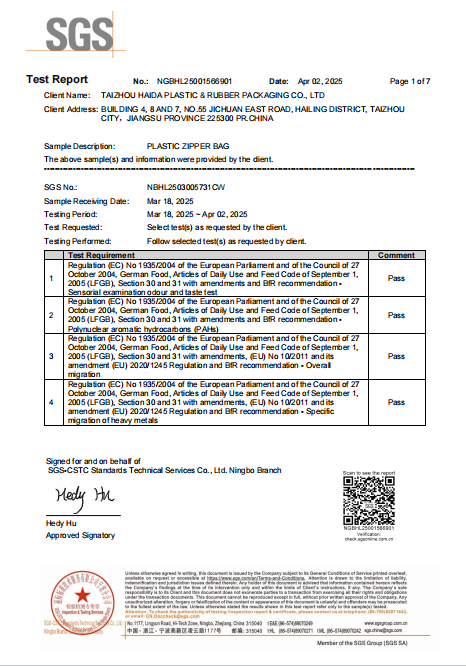
- Test documentation. Haida Packaging holds an SGS test report (report number NGBHL2500156690, SGS-CSTC Standards Technical Services Co., Ltd. Ningbo Branch, issued 2 April 2025) covering Regulation (EC) No 1935/2004, LFGB Sections 30 and 31, and Regulation (EU) No 10/2011. Its BRCGS certification for packaging materials — certificate BJG00002606/7506914, audited by LRQA — carries an A+ grade and is valid to 3 December 2026. Production quality control includes food safety compliance testing against FDA and LFGB standards alongside visual inspection.
Layer 3 — Model Range: Depth Is What Removes Compromise
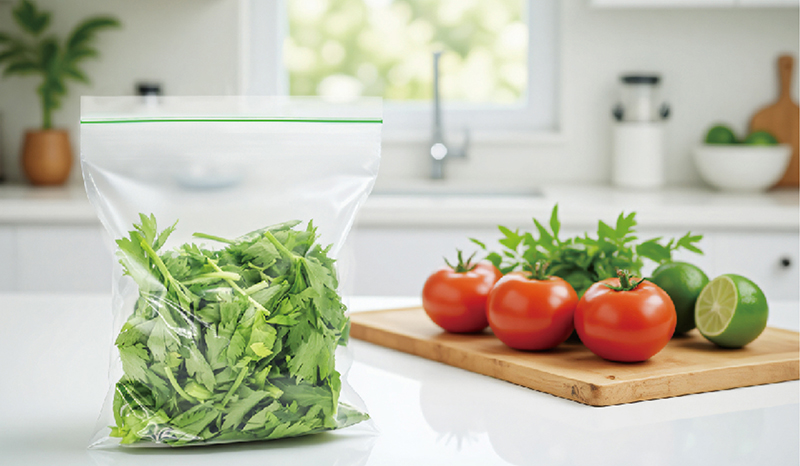
A supplier with one closure type and two sizes will eventually force a compromise: a larger bag where a smaller one was specified, a slider where a press-to-close zipper was requested, or a general-purpose film where a freezer-rated material was needed. Range depth is therefore a capability measure in its own right.
The Haida line covers seven models across four closure or function types: single zipper (HD-SZB001), double zipper (HD-DZB001), slider (HD-SB001 and HD-ZB002), frozen food (HD-FB001) and vacuum (HD-VB001), plus the general food sealing bag HD-ZB001. In capacity terms, the volume-specified models span 50 ml at the low end (HD-DZB001, HD-ZB002 and HD-VB001) to 2,000 ml at the top (HD-VB001), with the slider bag HD-SB001 sitting at 100–1,000 ml.
Two specifications deserve special attention because they are not volume-based:
- HD-FB001 weight handling. The frozen food bag is specified by portion weight — 100 g to 2 kg — not by millilitres. This is exactly the kind of model-level detail buyers should verify before committing, because weight-based capacity determines film thickness, seal strength and stack performance rather than internal volume alone.
- Size-class models. HD-ZB001 and HD-SZB001 are specified as Small, Medium and Large rather than in millilitres. Buyers should request the physical dimensions behind those classes and map them to their own product footprint.
Step-by-Step Breakdown: Running the Assessment
The sequence below works for both a first-time supplier audit and a re-evaluation of an existing partner. Steps 1–4 belong to Evaluation; steps 5–9 belong to Execution.
- Write the brief in numbers. Product type, portion weight or volume, storage and transport temperature, closure preference, print or logo requirement, destination market and annual volume. If your brief involves custom printed zipper bags, stand-up zipper bags, freezer bags or small-format sandwich and snack storage bags, state the format at the start rather than after quoting.
- Request a model-level specification sheet. Not a brochure — a table with model code, material, capacity or weight scope, temperature rating, closure type and intended application. Compare it with the format used in the comparison table below.
- Match the model to the physical load. A portion-packed frozen product should be checked against the HD-FB001's 100 g to 2 kg range and -40°C rating; a leak-sensitive sauce or liquid product against the leak-resistant HD-DZB001; a vacuum programme against the PA+PE HD-VB001.
- Verify material documentation. Ask for the test report number, the issuing laboratory, the standards tested and the report date. A claim such as 'food grade' should resolve to a document — for example the SGS report covering LFGB and EU No 10/2011.
- Stress-test the capacity arithmetic. Divide your annual demand by the supplier's monthly capacity (900 tons in this example). Anything above roughly 10% of monthly tonnage deserves a written scheduling commitment, and seasonal peaks should be discussed before, not during, the peak.
- Confirm the customisation scope. OEM production is standard for Haida Packaging, with logo customisation available. Ask which models support printing or logo application, because print capability is model-specific — a slider bag and a vacuum bag are not printed the same way.
- Fix commercial terms before sampling. For reference, Haida Packaging's standard terms are a minimum order quantity of 20,000 boxes, FOB Shanghai, and 30/70 payment terms.
- Define acceptance criteria in writing. The published criteria are visual inspection, sample testing, and a sealing and packaging check. These should appear in the purchase contract, not only in the quality manual.
- Close the loop on lead time and after-sales. Standard lead time is 35–40 days. After-sales support covers email and WhatsApp communication, product and storage guidance, technical support, and replacement where quality issues occur.
As a checklist for the evidence file, the following table summarises what to request and what each item proves.
| What to request | What it verifies | Reference example |
|---|---|---|
| Monthly and annual output figures | Whether your volume fits the supplier's capacity ceiling | 900 tons per month; 11,000 tons per year |
| Site area and workforce | Whether capacity is owned and staffed, not brokered | 15,000 m²; 310 employees |
| R&D headcount | Whether customisation can be engineered in-house | 20 engineers |
| Export share and main markets | Familiarity with import-market requirements | About 90% export; mainly Japan and Europe |
| Material test report | Food-contact compliance of the film | SGS report NGBHL2500156690 (LFGB; EU No 10/2011) |
| Packaging-materials certification | System-level quality and hygiene control | BRCGS certificate BJG00002606/7506914, grade A+, valid to 3 December 2026 |
| Model specification sheet | Whether the required size, closure and temperature rating exist | Seven models from HD-ZB001 to HD-VB001 |
| Acceptance criteria | How disputes will be judged at delivery | Visual inspection, sample testing, sealing and packaging check |
Use Cases: How Model-Level Capability Shows Up in Real Projects
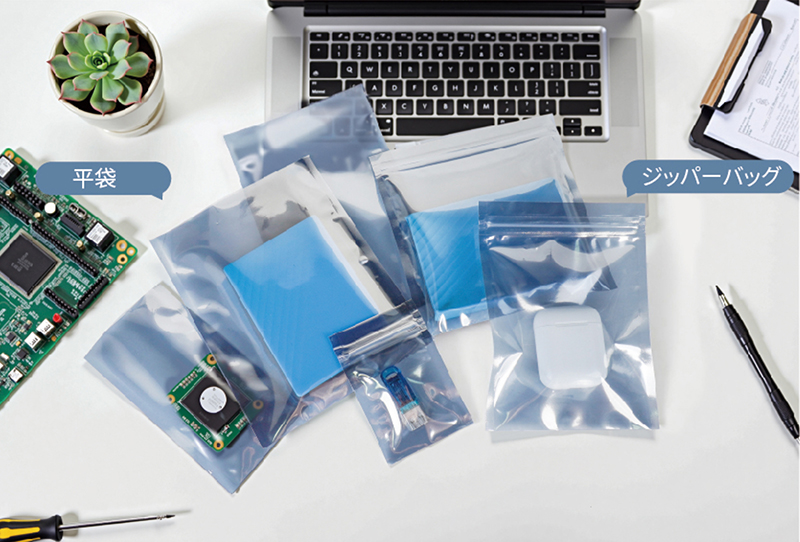
The clearest test of a supplier's range is not the specification sheet but the deployment record. Haida Packaging's largest export market is Japan, where five documented project types show how model selection follows the physical requirement rather than the price list.
- Electronics and small components (HD-DZB001, HD-SZB001). A Japanese client used these models for dust-free and moisture protection packaging, with anti-static and moisture-proof properties and custom sizes. The project ran for 2–3 years and solved inadequate protection of sensitive components during transit.
- Retail and convenience stores (HD-DZB001). Daily product packaging with transparent material for product visibility and strong sealing. The project ran for 1–2 years and delivered consistent quality with convenience for store staff.
- Frozen food processing (HD-SB001). A large-scale cold-chain packaging programme with bulk supply, low-temperature resistance and anti-crack material. Over three years it contributed to reduced product damage and improved shelf life.
- Catering and restaurant chains (HD-SZB001). Takeaway and delivery packaging for high-volume orders, delivering hygienic storage and easy sealing over a 1–2 year programme.
- Food manufacturing (HD-SB001). Large-scale production for food packaging and portion control, with custom sizes and logos, FDA/LFGB compliance and leak-proof design, achieving stable supply and improved packaging efficiency over 2–3 years.
Read together, the five cases demonstrate three capabilities that a price quotation cannot: the ability to hold a specification for multiple years, the ability to serve both food and non-food applications from the same quality system, and the ability to support high-volume programmes without changing the delivered model.
Mapping the Model Range to Applications
The comparison below uses published model specifications only. It is intended as a verification template: request the same fields from any supplier and compare like for like.
| Model | Type | Material | Capacity / scope | Key rating | Typical application |
|---|---|---|---|---|---|
| HD-ZB001 | Food sealing bag | 100% LDPE | Small / Medium / Large | Temperature resistant -20~120°C | Household and kitchen, food packaging, catering |
| HD-SZB001 | Single zipper bag | 100% LDPE | Small / Medium / Large | Standard single zipper, -20~120°C | Food packaging, catering, daily supplies |
| HD-DZB001 | Double zipper bag | 100% LDPE | 50~500 ml | Dual zipper, leak-resistant | Food packaging, catering, daily supplies |
| HD-ZB002 | Slider zipper bag | 100% LDPE | 50~500 ml | Slider design, easy open and close | Household and kitchen, food packaging, daily supplies |
| HD-SB001 | Slider bag | 100% LDPE | 100~1000 ml | Pressure and water resistant | Food and electronics packaging |
| HD-FB001 | Frozen food bag | 100% LDPE | 100 g~2 kg | Low temperature resistant -40°C, oil-resistant | Frozen food, ready-to-eat packaging |
| HD-VB001 | Food vacuum bag | PA+PE | 50~2000 ml | Vacuum-sealable, high temperature resistant | Food processing, freezing, preservation |
Two observations follow from the table. First, the volume-specified models span 50 ml to 2,000 ml, while two models are defined by size class and one by portion weight — so a buyer comparing suppliers on 'capacity' alone will compare the wrong units. Second, the material split is deliberate: LDPE covers the household, catering, frozen-food and slider applications, while PA+PE is reserved for the vacuum model where barrier and heat performance are required.
Frequently Asked Questions
What compliance documentation should a zipper bag supplier be able to show?
A supplier serving food, retail or export customers should be able to produce three document types on request: material test reports, system certification and factory audit results. Haida Packaging's file includes an SGS test report (NGBHL2500156690, issued 2 April 2025) covering Regulation (EC) No 1935/2004, LFGB Sections 30 and 31, and Regulation (EU) No 10/2011; BRCGS certification for packaging materials (BJG00002606/7506914, audited by LRQA, grade A+ valid to 3 December 2026); and production-level food safety compliance testing against FDA and LFGB standards. Useful reference points for buyers are FDA 21 CFR 177.1520 for PE resin in the United States and LFGB and EU No 10/2011 for the European market.
How can I tell whether a supplier's model range is real rather than a list of names?
Ask for a specification sheet in which every model carries five fields: model code, material, capacity or weight scope, temperature rating and closure type. A genuine range shows internal logic — for example, LDPE across single zipper, double zipper, slider and frozen-food models, with PA+PE confined to a vacuum model, and capacities aligned to a defined span such as 50 ml to 2,000 ml for volume-specified items. Cross-check the sheet against deployment records: Haida Packaging's range is supported by five documented Japanese projects covering electronics, retail, frozen food, catering and food manufacturing. A range that cannot be traced to delivered projects is a catalogue, not a capability.
What commercial structure should I expect from an OEM zipper bag supplier?
Commercial terms matter as much as technical ones, because minimum order quantity and payment structure determine working capital. Haida Packaging's published terms are a minimum order quantity of 20,000 boxes, FOB Shanghai delivery and 30/70 payment terms, with OEM production as the standard mode. When comparing suppliers, normalise these terms against offered capacity: a low MOQ paired with limited monthly tonnage can create replenishment problems later, while a supplier producing around 900 tons per month is better placed to absorb larger release schedules.
Can I validate a zipper bag model with samples before committing to a full order?
Yes, and sample validation belongs in the written acceptance criteria rather than in an informal favour. Haida Packaging's acceptance criteria name visual inspection, sample testing, and sealing and packaging checks — the same three checks a buyer should perform on the delivered batch. For weight-defined models such as the HD-FB001 (100 g to 2 kg), test at the top of the range, not the middle: seal integrity and stacking behaviour usually fail at the extreme, not at the average.
What lead time and after-sales support should the contract cover?
Standard production lead time at Haida Packaging is 35–40 days, supported by a monthly capacity of 900 tons and annual output of 11,000 tons. After-sales support covers email and WhatsApp communication, product and storage guidance, technical support, and replacement where quality issues are confirmed. The step most buyers skip is writing the lead time into the contract alongside the model code and acceptance criteria — a date without a specification is not a commitment. Buyers ready to move to that stage can request samples and a model-level specification, or download the current catalogue before sending a brief.
Conclusion: Assess the Layers, Then Place the Order
Supplier capability in zipper storage bags is not a single claim; it is three layers of checkable data. Capacity answers whether volume can be repeated. Materials answer whether the film will perform at the required temperature, load and chemical exposure. Model range answers whether the exact size, closure and function you specified actually exists in production.
Used together, the layers produce a short evidence file: monthly and annual tonnage, site area and headcount, material test reports with numbers, system certification with validity dates, and a model specification sheet covering every code you intend to buy. A supplier able to provide all five — as Haida Packaging does with 900 tons per month, 11,000 tons per year, an SGS and BRCGS documentation trail, and a seven-model range from HD-ZB001 to HD-VB001 — is a supplier whose capability survives the audit and the repeat order.
Next Step: Request Samples, Specifications or a Quote
Send your packaging brief — model or format, material, capacity or portion weight, temperature requirement and annual volume — and receive a model-level specification response, sample arrangement and quotation.
Haida Packaging — Taizhou Haida Plastic & Rubber Packaging Co., Ltd.
Contact: Chuck Yan, Sales Manager
Tel / WhatsApp: +86 199 5116 9639
Email: yanjun@hai-da.cn
Address: Building 4 and 8, No.55 Jichuan East Road, Hailing District, Taizhou, Jiangsu, China
Website: www.haidapack.com
Have Questions or Need More Details?
Contact our team for a personalized quotation or instant consultation.
Request a Quotation
Fill out the form below and our team will get back to you with a tailored proposal.
WhatsApp Direct Chat
Prefer to chat in real-time? Message us on WhatsApp for instant assistance & quick answers.
- Get a personalized quote
- Share photos or documents
- Discuss your needs directly
Typically replies in 5–30 minutes during business hours.