LDPE vs. PA+PE Zipper Bags: Material and Temperature Parameters
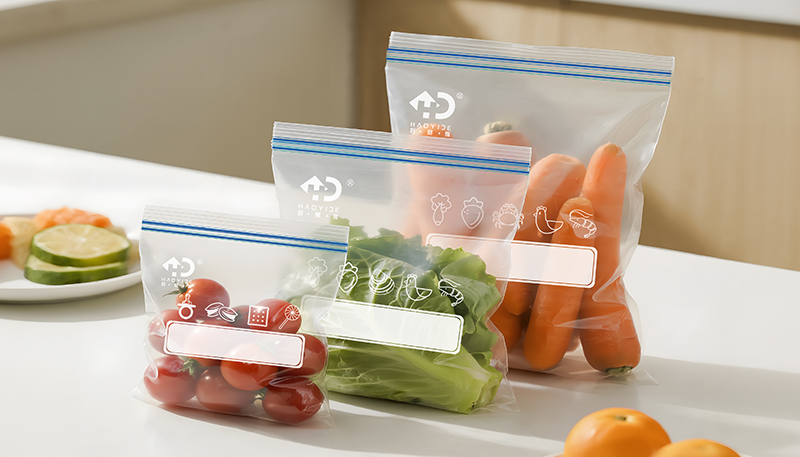
Buyers who reach the decision stage on zipper storage bags usually arrive with three specifications already fixed: size, print and zipper style. The fourth — material structure and its working temperature — is the one that decides whether the bag still performs in a freezer container, on a hot-fill line, or inside a vacuum pack.
Two structures dominate custom quotations in this category. The first is the 100% LDPE zipper bag, produced in configurations such as HD-ZB001, HD-ZB002, HD-SB001, HD-FB001, HD-SZB001 and HD-DZB001. The second is the PA+PE vacuum bag HD-VB001, a laminate built around a polyamide (PA / nylon) layer and a polyethylene (PE) sealing layer.
This guide compares the two on the parameter that separates them most clearly: temperature. It covers the −40 °C rating that applies to the frozen food bag in the LDPE range, the −20 °C to 120 °C working window specified for standard zipper storage bags, and the application conditions under which a PA+PE laminate becomes the more appropriate structure.
Problem Definition: The Parameter Most Often Left Off the Specification Sheet
Zipper bag failures in the field are usually temperature failures or sealing failures, and they arrive in that order. A film held outside its working window does not fail loudly — it cracks along folds after repeated handling, distorts at the seal after hot filling, or gradually loses the internal vacuum that the packaging format depends on. By the time the problem appears in a retail or food-service channel, the material decision was made months earlier.
Three parameters determine whether that happens:
1. Continuous working temperature. This is not the ambient temperature of the warehouse. It is the coldest point the filled bag meets (blast freezing, cold-chain transit, retail freezer) combined with the hottest point (hot fill, sealing, reheating or cooking instructions printed on the pack).
2. Structure. Mono-material 100% LDPE and a PA+PE laminate behave differently at both ends of that temperature range, and they are not interchangeable substitutions.
3. Sealing design. Within the same material, a single zipper, a double zipper or a slider sets the leak behaviour and the handling effort on the filling line. Temperature and seal must be specified together.
Buyers typically specify the first parameter loosely and the third not at all, leaving the supplier to apply a default. Compliance documentation is frequently confused with a temperature guarantee: food-contact approvals such as EU No 10/2011, LFGB or US FDA 21 CFR 177.1520 confirm that the resin is safe for food contact — they say nothing about whether the finished bag survives −40 °C or a hot fill.
Industry Background: Why Both Structures Are Growing
Demand is expanding across the whole category, which is why material selection questions now reach the quotation stage more often than they did a decade ago.
The global zipper bag market was valued at approximately USD 10.34 billion in 2024 and is projected to reach USD 19.44 billion by 2035, according to Market Research Future. Within that total, the stand-up zipper pouch segment alone was valued at USD 2.61 billion in 2024 and is expected to reach USD 3.80 billion by 2032, driven by the wider shift from rigid to flexible packaging (Market Research Future).
Food packaging accounts for roughly 39.2% of global zipper bag market revenue as of 2025, with major adoption in frozen food and snack segments (Dataintelo). That split matters for this comparison: frozen food applications pull demand toward low-temperature-capable LDPE structures, while snack, meal-kit and prepared-food applications push demand toward higher-barrier and vacuum formats.
Two further drivers are visible. The subscription-box and meal-kit delivery sector surpassed USD 20 billion in 2024, generating volume for custom-printed zipper bags used for ingredient portioning (Dataintelo). And Asia-Pacific remains the fastest-growing region for zipper bags, holding a significant share of global manufacturing capacity (Towards Packaging).
Published market estimates diverge by scope — some track retail food bags only, others include industrial packaging — with values ranging from about USD 2.45 billion (Cognitive Market Research) to USD 3.83 billion for a plastic-bag-focused definition (Global Growth Insights). Buyers should therefore treat headline market numbers as directional and rely on their own specification and volume data for sourcing decisions.
On the compliance side, zipper bags intended for food contact in the EU must comply with LFGB and EU No 10/2011, while BRCGS A+ and amfori BSCI operate as key entry barriers for major retailers. Food-grade polyethylene bags in the US market must follow FDA 21 CFR 177.1520 for resin composition and migration limits. Haida Packaging — Taizhou Haida Plastic & Rubber Packaging Co., Ltd., founded in 2003 in Taizhou, Jiangsu, China — manufactures zipper bags, single zipper bags and slider bags from a 15,000 m² facility with 310 employees, an annual output of 11,000 tons, a 20-engineer R&D team and an export ratio of approximately 90%, with Japan and Europe as its main markets. The company holds ISO9001, ISO14001, ISO22716, ISO13485, BRC, BRC-CP, BSCI, Nordic Swan, GMPc, FDA and EPA certifications.
Detailed Solution: How 100% LDPE and PA+PE Differ in Practice
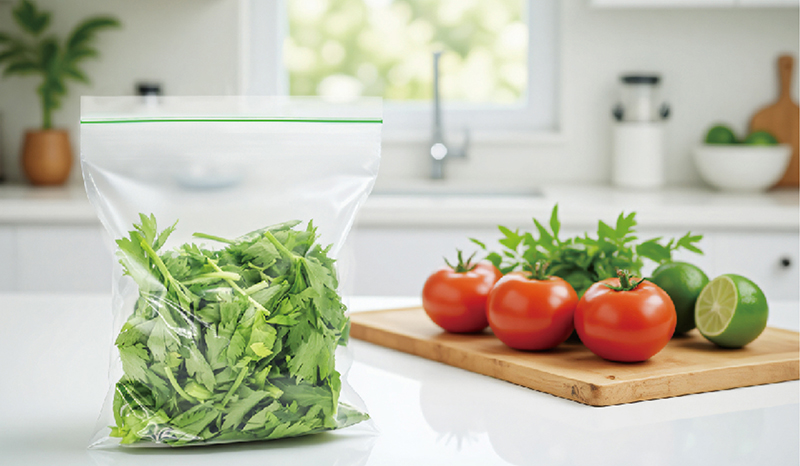
100% LDPE: the mono-material structure built for cold and everyday storage
Low-density polyethylene is a branched polyethylene. The branching reduces crystallinity, which is exactly why LDPE films stay flexible rather than turning rigid when the temperature drops — the property that makes the material suitable for freezer duty. In the Haida range, 100% LDPE structures cover HD-ZB001, HD-ZB002, HD-SB001, HD-FB001, HD-SZB001 and HD-DZB001, spanning single zipper, double zipper, slider, stand-up and freezer bag configurations.
On temperature, two specifications apply. The frozen food bag in this range is rated to −40 °C, which places it in deep-freeze and blast-freeze territory where many general-purpose films become brittle. Standard zipper storage bags in the same mono-material family are specified across a working window of −20 °C to 120 °C.
On food contact, LDPE is a well-established food-contact resin: in the US market, PE bags must follow FDA 21 CFR 177.1520 for resin composition and migration limits, and EU-market food zipper bags sit under LFGB and EU No 10/2011.
Where LDPE does not compete is vacuum retention. A mono-material LDPE bag is designed for atmospheric packaging, portioning and storage — not for holding an internal vacuum over a long shelf life. Selecting it for a vacuum application is a structure error, not a specification tweak.
PA+PE: the laminate structure for vacuum duty and heat exposure
The PA+PE vacuum bag HD-VB001 combines a polyamide (nylon) layer with a polyethylene layer. The division of labour is straightforward: the PA layer contributes mechanical strength, puncture resistance and dimensional stability; the PE layer provides the heat-sealable, food-contact inner surface that closes the bag and holds the vacuum.
This structure is chosen when the pack must hold vacuum, when the filled bag faces abrasion and puncture risk in transit, or when the application sits at the heated end of the temperature range. In those conditions, a mono-material PE bag is the wrong tool, regardless of how thick the film is.
The trade-offs are equally clear and should be part of the quotation review. A laminate cannot be sorted into a mono-material PE recycling stream in the same way, and the material cost is higher than a single-zipper LDPE bag. More importantly for engineering, the usable temperature window of a PA+PE structure is defined by the gauges of both layers and by the seal geometry — not by a single generic number. The rating for HD-VB001 must therefore be confirmed against the specific construction being quoted and validated on the finished bag, not assumed from the material name.
Where the two structures overlap — and where they do not
Between roughly −20 °C and the upper end of the standard zipper bag window, both structures can be technically viable, and the decision shifts to vacuum retention, puncture exposure and cost. Below −20 °C — that is, in the deep-freeze band down to −40 °C — the freezer bag in the 100% LDPE range is the specified choice. Where the pack must hold vacuum or face the heated end of the range, the PA+PE laminate takes over. The practical decision rule is to specify the extreme temperatures first, then the structure, then the seal.
Step-by-Step Breakdown: A Six-Step Material Selection Sequence
Step 1 — Fix the two extreme temperatures. Write down the coldest point the filled bag will meet (for example, deep-freeze storage at the −40 °C end, or cold-chain transit) and the hottest point (hot fill, sealing, or reheating instructions). These two numbers, not the average, drive everything that follows.
Step 2 — Decide vacuum or atmospheric. If the pack must hold an internal vacuum across the shelf life, the specification belongs to the PA+PE laminate family (HD-VB001). If it is portioning, storage or retail display at atmospheric pressure, a 100% LDPE structure is the correct starting point.
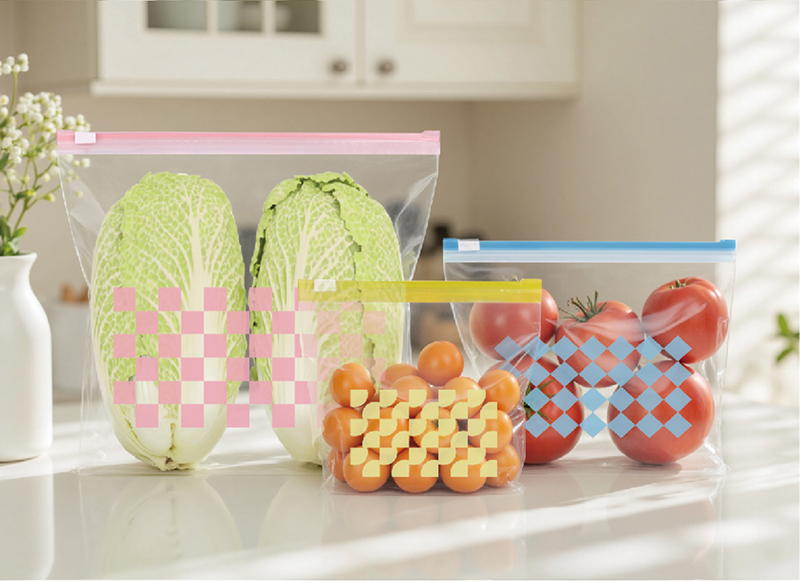
Step 3 — Select the sealing design. Within the LDPE range, single zipper, double zipper and slider are not interchangeable on either performance or cost. Use the sealing comparison in the next section to match the design to handling frequency and leak risk.
Step 4 — Map the compliance route by destination market. EU food-contact applications require LFGB and EU No 10/2011 conformity; US food-contact PE bags require FDA 21 CFR 177.1520 conformity; BRCGS A+ and amfori BSCI are typically required by major retail chains. Confirm that the certificate applies to the exact structure and model being quoted.
Step 5 — Validate on samples, not on datasheets. Order samples of the exact model and run a validation protocol: freeze/thaw cycling, hot-fill and seal integrity checks, drop testing at the intended load, and functional testing of the zipper or slider. Haida Packaging applies visual inspection, sealing pressure testing and SGS verification before shipment, functional pre-shipment testing of slider smoothness and sealing reliability, in-line QC at critical process steps, and defect tracking with corrective action as part of its standard quality controls.
Step 6 — Close the handling and logistics loop. Confirm carton packaging, palletizing and handling instructions for safe transport, and require clear end-user instructions covering opening and closing, temperature limits and load limits. Customer misuse — overloading a bag or exposing it beyond its stated temperature window — is one of the most common causes of premature failure, and it is controlled by labelling rather than by material.
Use Cases: Matching Structure to Application
Frozen food, meal kits and ice-cream portioning. The controlling requirement is low-temperature flexibility. The freezer bag in the 100% LDPE range, rated to −40 °C, is specified for this band, and the format also covers custom freezer bag and custom food grade zipper bag enquiries where portioning and reclosure matter.
Household and kitchen organisation. Single zipper LDPE bags are suited to household and kitchen use, retail food packaging and portioned storage, including stand up zipper storage bags, small size zipper storage bags and large size zipper storage bags. The single zipper design provides approximately 30% higher sealing reliability and better leak-proof performance than traditional poly bags, at a cost approximately 5–10% higher.
High-volume food packaging, takeaway and liquids. Here leak risk dominates. The double zipper design showed approximately 30–40% fewer leakage complaints in B2B trials compared with alternatives, at a unit cost approximately 10–15% higher. Maintenance requires manual or semi-automatic operation with slightly more effort to align the two zippers — a line-side consideration worth testing before committing to a high-speed filling setup.
Retail, portioned frozen foods and small electronics. Frequent access favours the slider mechanism, which supports approximately 50% faster opening and closing than traditional zipper bags with minimal maintenance due to the durable slider. Its cost is higher than a single zipper but comparable to a double zipper.
Vacuum and heated applications. The PA+PE vacuum bag HD-VB001 covers vacuum packing and packs that sit at the heated end of the range, where a mono-material LDPE bag would not be specified.
Non-food storage. The same LDPE construction is used for custom clothing zipper bags, custom clear zipper bags and general resealable storage. When the bag is repurposed outside food contact, the food-grade certification route is no longer the governing requirement — but the temperature window still is.
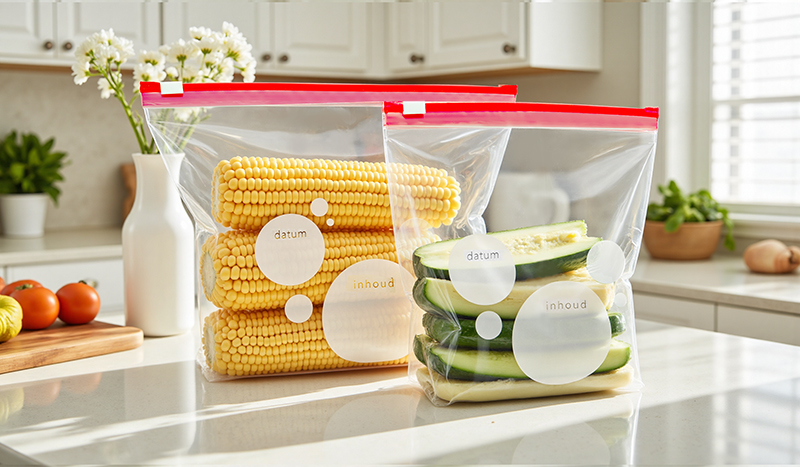
Comparison Table: LDPE vs. PA+PE at a Glance
The tables below summarise the material parameters and the sealing-design parameters that belong on the same specification sheet.
Table 1 — Structure and temperature comparison
| Parameter | 100% LDPE zipper bags (HD-ZB001, HD-ZB002, HD-SB001, HD-FB001, HD-SZB001, HD-DZB001) | PA+PE vacuum bag (HD-VB001) |
|---|---|---|
| Material structure | Mono-material, 100% low-density polyethylene | Polyamide (PA / nylon) layer combined with a polyethylene (PE) layer |
| Working temperature — frozen end | Freezer bag rated to −40 °C | Confirm against the specific construction and seal geometry |
| Working temperature — standard range | −20 °C to 120 °C for standard zipper storage bags | Selected for applications at the heated end of the range |
| Primary barrier role | Moisture barrier with food-contact PE resin | Added mechanical strength and puncture resistance from the PA layer |
| Vacuum retention | Not the intended duty | Primary design duty |
| Sealing options in range | Single zipper, double zipper, slider, stand-up, freezer bag | Vacuum seal |
| Food-contact compliance route | EU LFGB and EU No 10/2011; US FDA 21 CFR 177.1520 for PE resin | Same food-contact framework; confirm per structure |
| Recycling characteristic | Mono-material stream | Multi-material laminate cannot be sorted as a mono-material PE stream |
Table 2 — Sealing design comparison inside the LDPE range
| Sealing design | Documented performance difference | Cost position | Best-fit applications |
|---|---|---|---|
| Single zipper | Approximately 30% higher sealing reliability and better leak-proof performance than traditional poly bags; consistent quality reduces rework | Approximately 5–10% higher than traditional poly bags | Household and kitchen, retail food packaging, portioned storage |
| Double zipper | Approximately 30–40% fewer leakage complaints in B2B trials; manual or semi-automatic operation requires slightly more effort to align zippers | Approximately 10–15% higher unit cost | High-volume food packaging, takeaway, liquids |
| Slider | Approximately 50% faster opening and closing than traditional zipper bags; minimal maintenance due to a durable slider | Higher than single zipper, comparable to double zipper | Household, retail, portioned frozen foods, small electronics |
FAQ
Do LDPE and PA+PE zipper bags follow the same food-contact compliance rules?
They sit under the same regulatory framework, but the documentation has to match the exact structure. Food-contact zipper bags for the EU market must comply with LFGB and EU No 10/2011, and BRCGS A+ and amfori BSCI act as key entry barriers for major retailers. In the US market, food-grade polyethylene bags must follow FDA 21 CFR 177.1520 for resin composition and migration limits. Haida Packaging holds ISO9001, ISO14001, ISO22716, ISO13485, BRC, BRC-CP, BSCI, Nordic Swan, GMPc, FDA and EPA certifications. Note that none of these approvals define a temperature limit — compliance and thermal performance are separate specifications.
Can one supplier deliver both a −40 °C freezer bag and a vacuum laminate?
Capability here means more than owning a bag-making machine. Haida Packaging manufactures zipper bags, single zipper bags and slider bags across both structures, with a 20-engineer R&D team, an annual output of 11,000 tons, and a factory of 15,000 m² employing 310 people, exporting approximately 90% of output mainly to Japan and Europe. Process capability is supported by in-line QC at critical steps, defect tracking with corrective action, sealing pressure testing and SGS verification before shipment, and functional pre-shipment testing of slider smoothness and sealing reliability.
How much more does better sealing performance cost?
Within the 100% LDPE range, the documented cost steps are clear: a single zipper bag costs approximately 5–10% more than a traditional poly bag while delivering approximately 30% higher sealing reliability; a double zipper bag carries approximately 10–15% higher unit cost against alternatives while showing approximately 30–40% fewer leakage complaints in B2B trials; and a slider bag costs more than a single zipper but is comparable to a double zipper. Each step should be evaluated against the cost of a leak in your own channel, not against the unit price alone.
How should a buyer validate a temperature claim before ordering?
Request samples of the exact model — for example the freezer bag in the LDPE range or the PA+PE vacuum bag HD-VB001 — and test the finished bag rather than the resin. Freeze/thaw cycling, hot-fill and seal integrity checks, drop testing at the intended load, and zipper or slider functional testing will surface most temperature- and seal-related failures before a production run. Haida Packaging supports this with sample checks as part of its production control process and pre-shipment verification.
What should be confirmed before a first production order is released?
Four items close the loop: the exact structure and model, the certificate pack that applies to it, the sealing design matched to handling frequency, and the packaging and palletizing instructions for safe transport. Also confirm that end-user labelling covers opening and closing, temperature limits and load limits, since misuse is a recognised failure cause that material selection alone cannot prevent. To move from evaluation to validation, you can request samples or a quotation for your target models through haidapack.com, or download the full Taizhou Haida Catalogue 2025 for the complete model list.
Conclusion
LDPE and PA+PE zipper bags are not competing versions of the same product — they are answers to two different questions. The freezer bag in the 100% LDPE range, rated to −40 °C, answers the cold-chain question. Standard zipper storage bags across the −20 °C to 120 °C window answer the everyday storage, retail and portioning question. The PA+PE vacuum bag HD-VB001 answers the vacuum and heated-application question, where a mono-material film is not the specified tool.
The practical sequence does not change with order size. Fix the extreme temperatures, decide vacuum or atmospheric, choose the sealing design against real handling frequency, confirm the compliance route for the destination market, and validate on samples. Buyers who specify material and temperature before price avoid the most expensive category of packaging error: a technically compliant bag that fails in the freezer or at the seal.
Next Step
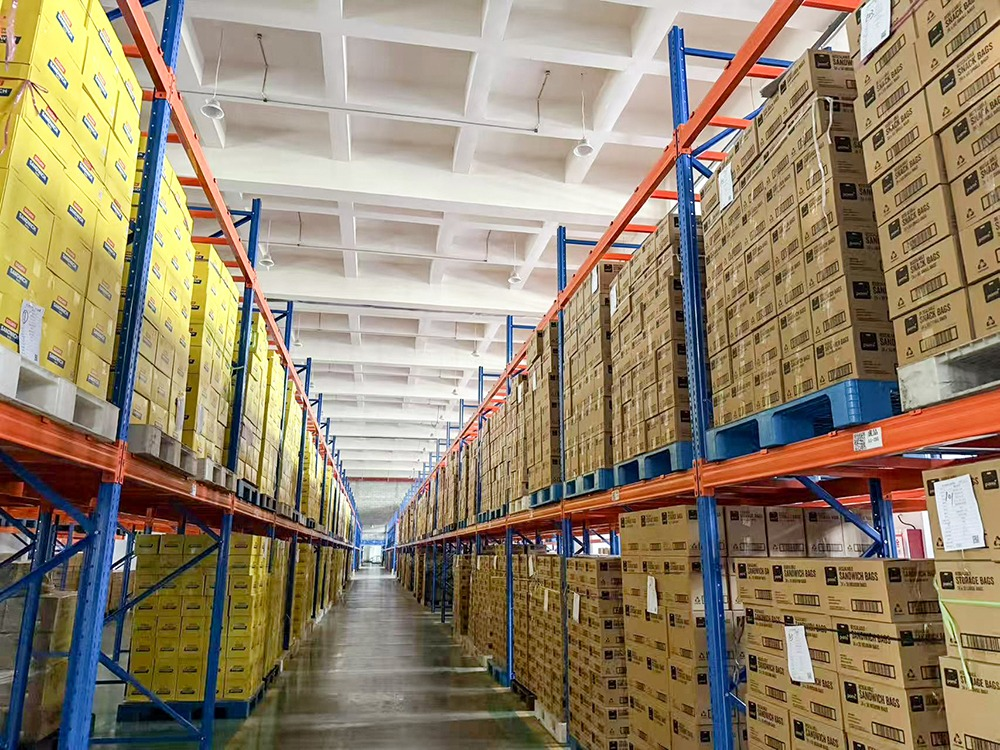
Tell us the coldest and hottest temperature your filled bag will meet, and we will confirm the structure, the sealing design and the certification pack that fit. Sample requests, quotations and OEM customisation enquiries are welcome.
Haida Packaging — Taizhou Haida Plastic & Rubber Packaging Co., Ltd.
Website: www.haidapack.com
Contact: Chuck Yan (Sales Manager) · Tel / WhatsApp: 19951169639 · Email: yanjun@hai-da.cn
Address: Building 4 and 8, No.55 Jichuan East Road, Hailing District, Taizhou, Jiangsu, China
Catalogue download: Taizhou Haida Catalogue 2025 (PDF)
WhatsApp: Start a conversation
Have Questions or Need More Details?
Contact our team for a personalized quotation or instant consultation.
Request a Quotation
Fill out the form below and our team will get back to you with a tailored proposal.
WhatsApp Direct Chat
Prefer to chat in real-time? Message us on WhatsApp for instant assistance & quick answers.
- Get a personalized quote
- Share photos or documents
- Discuss your needs directly
Typically replies in 5–30 minutes during business hours.