Food-Grade Zipper Storage Bags: Certification vs. Model Specification Guide
Food-Grade Zipper Storage Bags: Which Model Meets Your Market's Compliance Rules?
Buyers evaluating food-grade zipper storage bags often face the same problem: the supplier has a list of certifications, and it has a list of product specifications, but the two lists do not always connect. A certificate alone does not tell you which model it covers, which market it applies to, or whether the material parameters actually fit your frozen food, snack, takeaway, or retail application.
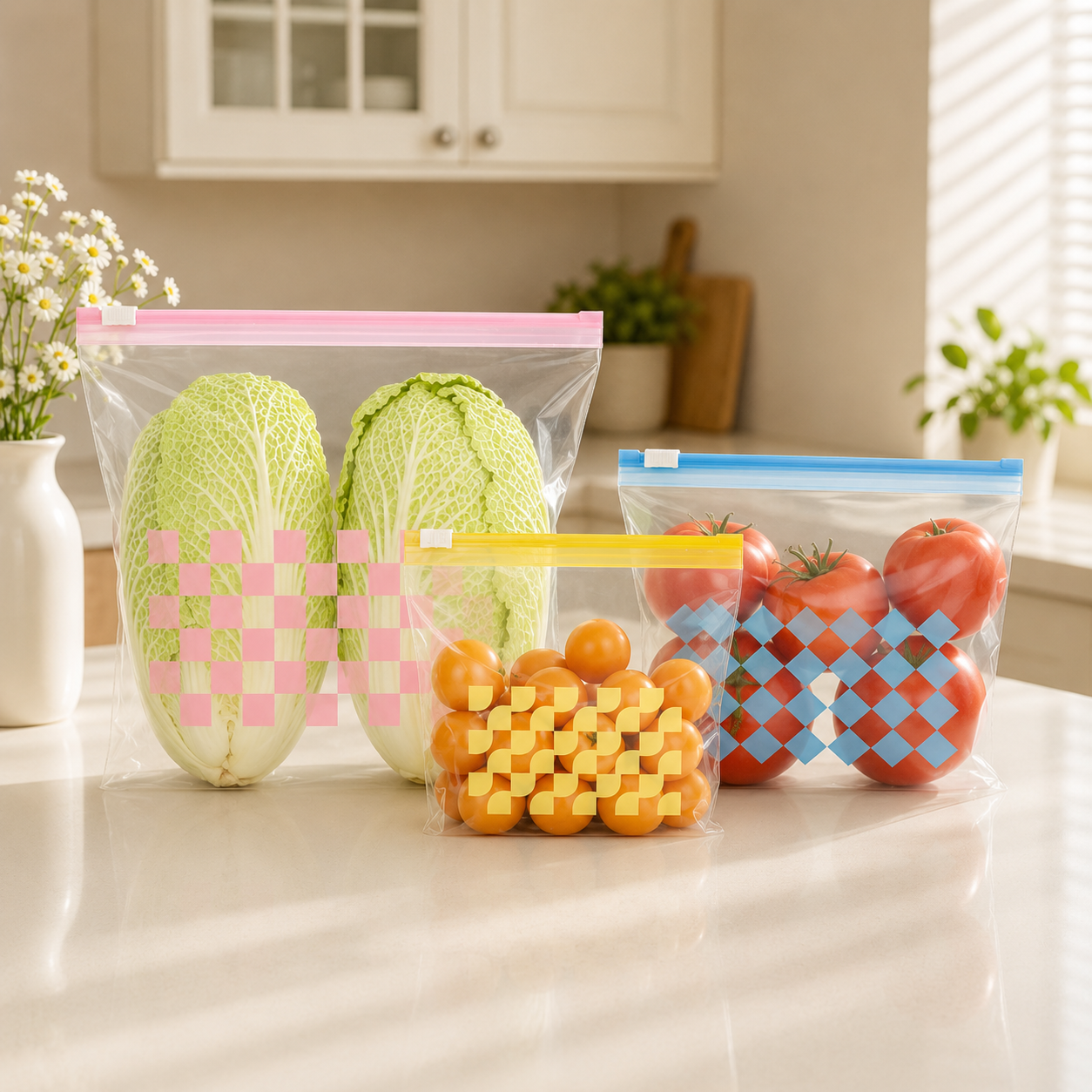
The practical answer is to make that connection explicit. Food-grade compliance is only meaningful when four elements line up: the target market's regulations, a specific product model, its material and performance parameters, and a valid certificate or test report that names that coverage. This article uses the product line and certification records of Haida Packaging as a documented working example so that buyers can see how to check alignment during the Research and Evaluation stages.
Haida Packaging is the brand of Taizhou Haida Plastic & Rubber Packaging Co., Ltd., a manufacturer based in Taizhou, Jiangsu, China, that has specialized in self-sealing bags and zipper bags since 2003. Around 90% of its output is exported, mainly to Japan and Europe. The company operates from a 15,000 m² factory area with approximately 310 employees and an annual output of about 11,000 tons, which makes its documentation and product data a practical reference for cross-border buyers.
The Hidden Gap Between a Certificate and a Bag
Several issues create confusion in compliance evaluation:
- A certification may cover one product line but not another. A food-contact test for a double zipper bag does not automatically apply to a slider bag, a frozen food bag, or a vacuum bag.
- Certificates are time-limited. Audits and test reports have issue dates and expiry dates. A document that looked valid during initial research may no longer be current by the time an order is released.
- Market rules differ. The EU applies Regulation (EC) No 1935/2004 and, for Germany, LFGB Section 30 and 31. The US applies FDA 21 CFR 177.1520 for food-grade polyethylene. A single certificate cannot cover every market.
- Specifications affect compliance. If a bag is described as food-grade but its temperature range does not suit freezer storage, the real constraint is not the certificate; it is the application condition.
At the evaluation stage, three verification questions matter more than the certificate itself. First, does the certificate name the model you plan to buy? Second, is the issuing body recognized in your destination market? Third, is the document still within its validity period? When a supplier can answer all three questions with a document number, the evidence becomes verifiable rather than promotional.
Why Food-Safe Compliance Is the Real Market Gatekeeper
The zipper bag market is large and still expanding. According to Market Research Future, the global zipper bag market was valued at approximately USD 10.34 billion in 2024 and is projected to reach USD 19.44 billion by 2035. Within that market, food packaging accounted for roughly 39.2% of global zipper bag revenue as of 2025, with substantial adoption in frozen food and snack segments, according to Dataintelo. Asia-Pacific has been the fastest-growing region for zipper bags and holds a significant portion of global manufacturing capacity, based on data from Towards Packaging.
Regulations are the main entry barrier for suppliers that want to serve premium retail chains. In the EU, food-contact zipper bags must comply with Regulation (EC) No 1935/2004 and Regulation (EU) No 10/2011. The German market additionally applies LFGB Section 30 and 31. BRCGS certification and amfori BSCI are commonly cited as key entry requirements for major European and global retailers. In the US, food-grade polyethylene bags are subject to FDA 21 CFR 177.1520 for resin composition and migration limits.
For buyers, this means a supplier's compliance package has to be matched to the destination market before price or lead time becomes the deciding factor. Food-contact regulations are based on migration and material safety, which is why the material declaration matters as much as the certificate. A clear statement such as “100% LDPE” is the starting point; the certificate confirms that the material has been tested under the relevant regulation.
A Model-Level View: Certifications at Haida Packaging
Haida Packaging's main product categories are zipper bags, single zipper bags, and slider bags. Its documented certifications can be mapped to specific models and markets as follows.
ISO 9001:2015 — Quality Management System
The zipper storage bag product range has been certified to ISO 9001:2015 under certificate number 15/25Q5282R31, issued by ISO Certification Body. The certificate applies globally and covers the quality management system of production. The document was issued on 24 March 2025. Because quality-system certificates are time-limited, buyers should request the current certificate during supplier evaluation rather than relying on a brochure screenshot.
BRCGS A+ — Packaging Materials Standard
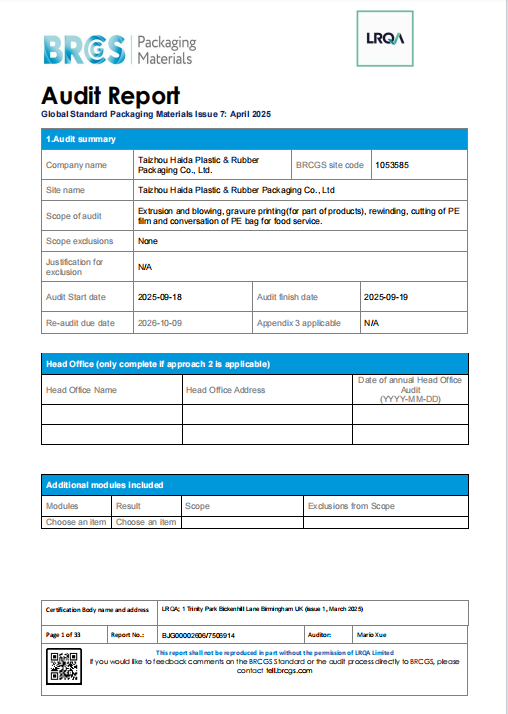
The HD-ZB001 food sealing bag is certified to the BRCGS Global Standard for Packaging Materials with an A+ audit grade. The certification is issued by LRQA under certificate number BJG00002606/7506914, and applies to the UK, Europe, North America, and global premium retail and supermarket supply chains. The current certificate is retained until 3 December 2026. For a buyer supplying UK or EU supermarkets, this is the document a retailer's quality team will ask to see before listing the product.
SGS Food-Contact Testing — EU and German Markets
The HD-DZB001 double zipper bag has been tested in accordance with Regulation (EC) No 1935/2004 and LFGB Section 30 and 31. The test report, number NGBHL2500156690, was issued by SGS-CSTC Standards Technical Services Co., Ltd., Ningbo Branch, on 2 April 2025, covering the German and European Union markets. For a buyer sending packaged food to Germany, this report is the document that translates LFGB compliance into a verifiable reference number. Test reports are also time-limited, so the latest version should be requested during evaluation.
amfori BSCI Grade A — Social Compliance
The zipper bag product line is certified to the amfori BSCI Code of Conduct, achieving Grade A. The certification is issued by Bureau Veritas Hong Kong Limited (BV) under certificate number 25-0344964 and applies to European and global premium retail and multinational supermarket supply chains. The current report is valid until 30 September 2026. For buyers sourcing from Asia, BSCI is not a food-safety certificate; it is a social audit that supplier qualification teams often require before onboarding a new factory.
The Product Line Behind the Certifications
Certifications need to be read together with product parameters. The documented models in Haida's food packaging range include the following:
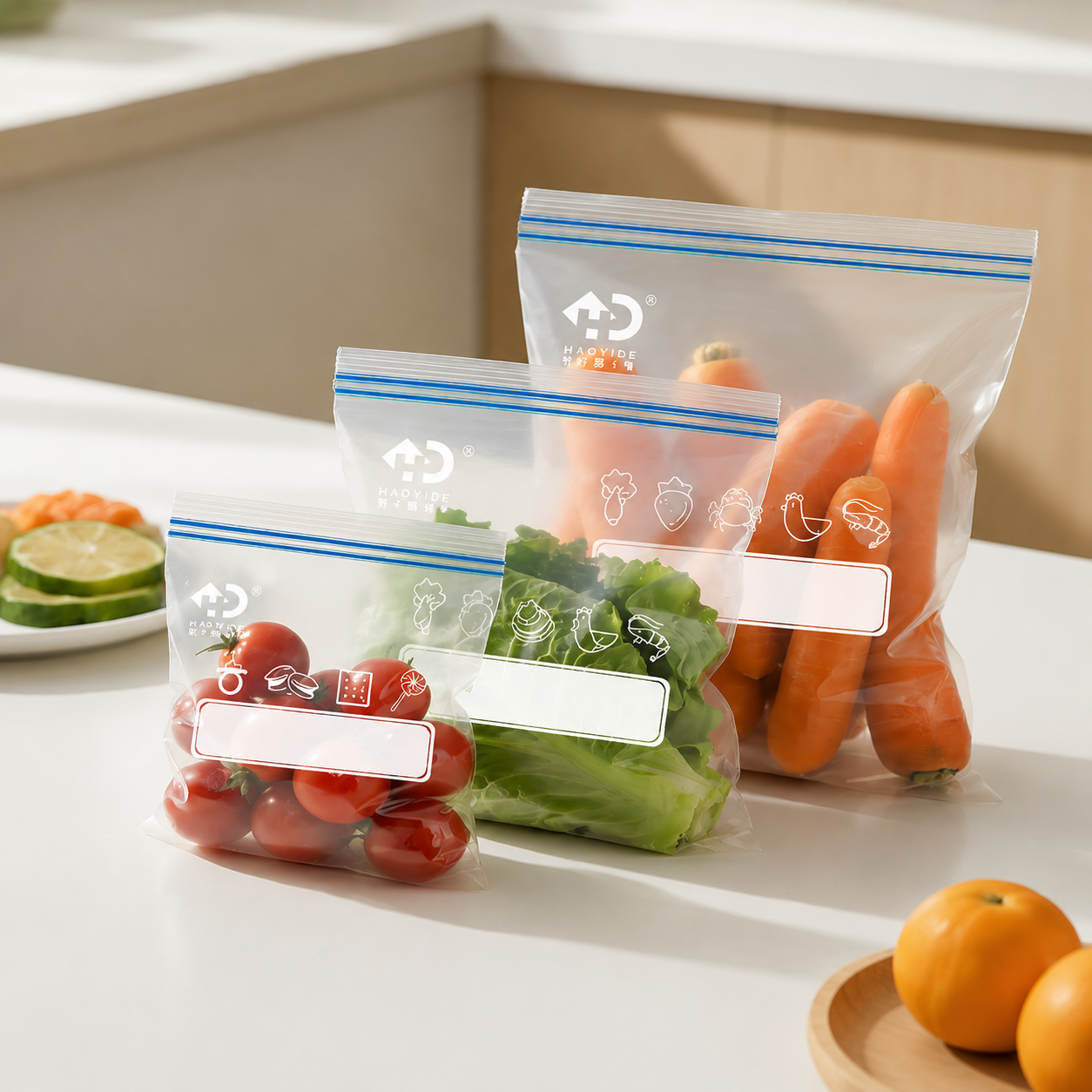
- HD-ZB001 — Food Sealing Bag, 100% LDPE, suitable for food storage, temperature resistant −20 to 120°C, sizes Small/Medium/Large. Applicable to household, kitchen, food packaging, and catering.
- HD-DZB001 — Double Zipper Bag, 100% LDPE, dual zipper for extra sealing, leak-resistant, easy to open and close, capacity 50–500 ml. Applicable to food packaging, catering, and daily supplies.
- HD-SZB001 — Single Zipper Bag, 100% LDPE, standard single zipper for food storage, temperature resistant −20 to 120°C. Applicable to food packaging, catering, and daily supplies.
- HD-SB001 — Slider Bag, 100% LDPE, convenient sealing, pressure and water resistant, capacity 100–1000 ml. Applicable to food and electronics packaging.
- HD-ZB002 — Slider Zipper Bag, 100% LDPE, slider design, easy to open and close, capacity 50–500 ml. Applicable to household, kitchen, food packaging, and daily supplies.
- HD-FB001 — Frozen Food Bag, 100% LDPE, low temperature resistant to −40°C, oil-resistant, capacity 100 g–2 kg. Applicable to frozen food and ready-to-eat packaging.
- HD-VB001 — Food Vacuum Bag, PA+PE, vacuum-sealable, high temperature resistant, capacity 50–2000 ml. This is not a zipper bag but is part of the same food packaging family for processing, freezing, and preservation.
5 Steps to Match a Market's Rules to a Specific Model
A practical evaluation route looks like this:
- Define the destination market's food-contact rules. For the EU, ask for evidence of compliance with Regulation (EC) No 1935/2004, Regulation (EU) No 10/2011, and, for Germany, LFGB Section 30 and 31. For the US, ask how the supplier verifies FDA 21 CFR 177.1520. For retail programs, ask whether BRCGS and amfori BSCI documentation is available.
- Select the bag type by application. Use a single zipper bag for general food storage (HD-SZB001 or HD-ZB001), a double zipper bag for leak-resistant catering use (HD-DZB001), a slider bag for high-frequency open-close cycles (HD-SB001 or HD-ZB002), and a frozen food bag if storage at −40°C is required (HD-FB001).
- Cross-check certificate coverage. Confirm the certificate number, the issuing body, the audit grade, the model it covers, and the expiry date. In the examples above, HD-ZB001 is the model named in the BRCGS certificate, while HD-DZB001 is the model named in the SGS food-contact test report. ISO 9001 and BSCI cover the production system and the product line rather than a single model.
- Verify quality control. Ask how the supplier checks each batch. Haida's documented OEM quality control includes food safety compliance testing (FDA/LFGB) and visual inspection. The factory also operates under the ISO 9001 quality management system, which is the procedural layer behind the test reports.
- Confirm OEM and production readiness. If the project requires custom printed zipper bags, custom slider zipper bags, or custom sizes, check whether the supplier supports OEM production, what the monthly capacity is, what the MOQ is, and how the lead time fits your launch plan. Haida's documented OEM parameters include a monthly capacity of 900 tons, an MOQ of 20,000 boxes, and a lead time of 35–40 days.
What Compliance Looks Like in Real Use Cases
Documented customer cases for Haida's zipper bags come from Japan and cover different operational conditions.
Food manufacturer — large-scale production. A Japanese food manufacturer used zipper bags for food packaging and portion control over a two-to-three-year relationship. The project achieved stable supply and improved packaging efficiency. The requirements included custom sizes and logos, compliance with FDA/LFGB, and a leak-proof design. This is an example of model-level compliance: the specification, the certificate, and the application were agreed before mass production.
Frozen food processor — cold chain. A Japanese frozen food processor ran a large-scale cold chain packaging project for three years using slider bags. Low-temperature resistance and anti-crack material were the key requirements. The documented result was reduced product damage and improved shelf life. In the product line, HD-FB001 is the model with a −40°C rating, while slider bags were used in the reported case for freezer storage.
Catering and restaurant chain — takeaway. A Japanese catering chain used single zipper bags for takeaway and delivery packaging over one to two years. The applicable model was HD-SZB001. Staff needed easy sealing for high-volume orders and hygienic storage. When extra sealing and leak resistance are the priority, the HD-DZB001 double zipper bag is the documented alternative.
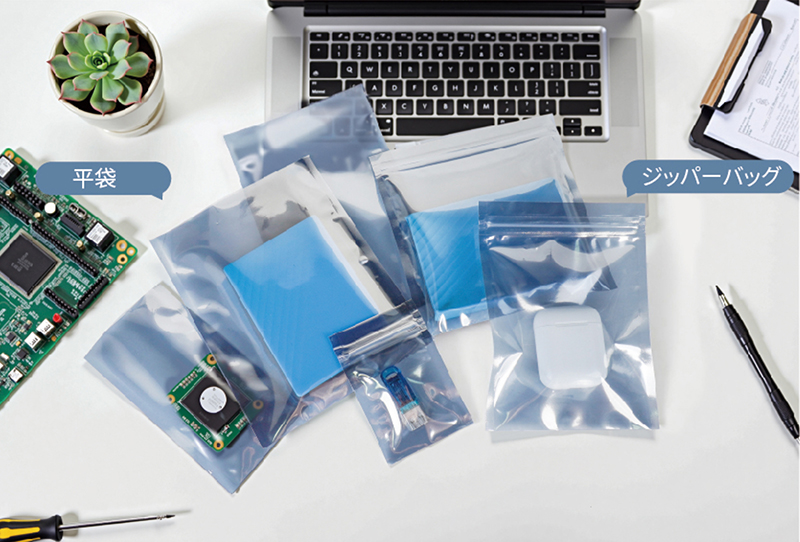
Electronics and small components — moisture protection. An electronics parts buyer in Japan used zipper bags for dust-free and moisture-protection packaging over two to three years. The project highlighted anti-static and moisture-proof properties, custom sizes, and the need to protect sensitive components during transit. HD-SB001 is the documented slider bag model for food and electronics packaging.
Retail and convenience store — product visibility. A Japanese retail and convenience store chain used double zipper bags for daily product packaging over one to two years. Transparent material and strong sealing were the defining requirements. This use case shows that compliance matters not only for food safety but also for the physical traceability and visibility of packaged goods on the shelf.
Zipper Storage Bag Specification and Certification Reference
| Model | Type | Material | Size / Capacity | Key Parameters | Documented Compliance |
|---|---|---|---|---|---|
| HD-ZB001 | Food Sealing Bag | 100% LDPE | Small / Medium / Large | −20 to 120°C | BRCGS A+ (BJG00002606/7506914); ISO 9001:2015 |
| HD-DZB001 | Double Zipper Bag | 100% LDPE | 50–500 ml | Dual zipper, leak-resistant | SGS food-contact report (NGBHL2500156690; LFGB + EC 1935/2004) |
| HD-SZB001 | Single Zipper Bag | 100% LDPE | Small / Medium / Large | −20 to 120°C | amfori BSCI Grade A (25-0344964); ISO 9001:2015 |
| HD-SB001 | Slider Bag | 100% LDPE | 100–1000 ml | Pressure & water resistant | ISO 9001:2015; covered by BSCI product-line audit |
| HD-ZB002 | Slider Zipper Bag | 100% LDPE | 50–500 ml | Slider design, easy open/close | ISO 9001:2015; covered by BSCI product-line audit |
When reading this table, note that BRCGS and SGS documents are model-specific, while ISO 9001 and BSCI cover the factory's management system and the zipper bag product line. This distinction is exactly what a buyer should verify with any supplier before placing an order.
Frequently Asked Questions
What food-contact certifications should a zipper storage bag supplier hold for the EU market?
For the EU, a supplier should be able to demonstrate compliance with Regulation (EC) No 1935/2004 and Regulation (EU) No 10/2011; if the destination is Germany, LFGB Section 30 and 31 also applies. BRCGS certification and amfori BSCI are commonly required to enter premium retail and supermarket supply chains. As a documented reference, Haida Packaging holds a BRCGS A+ certificate (BJG00002606/7506914) for HD-ZB001, an SGS food-contact test report (NGBHL2500156690) covering LFGB and EC 1935/2004 for HD-DZB001, and an amfori BSCI Grade A certificate (25-0344964) for the zipper bag product line.
Does the HD-DZB001 double zipper bag comply with German LFGB requirements?
Yes. The HD-DZB001 double zipper bag has been tested in accordance with Regulation (EC) No 1935/2004 and LFGB Section 30 and 31. The test report, number NGBHL2500156690, was issued by SGS-CSTC Standards Technical Services Co., Ltd., Ningbo Branch, and covers the German and European Union markets. Because test reports are time-limited, request the latest version during supplier evaluation.
Can you customize zipper storage bags with printed logos and specific sizes?
Yes. Haida Packaging supports OEM production with customization of voltage and logo printing. The documented monthly capacity is 900 tons, and the main export markets are Japan and Europe. For custom projects, the quality control process includes food safety compliance testing (FDA/LFGB) and visual inspection of each batch.
What is the minimum order quantity for custom zipper bags?
The documented MOQ for OEM orders at Haida Packaging is 20,000 boxes. Buyers planning custom printed zipper bags, custom slider zipper bags, or custom clear zipper bags should include this MOQ in their packaging forecast and budget before requesting a quote.
Can I request samples before placing a bulk order?
Buyers can request samples as part of the evaluation process. Haida's documented support includes product guidance via email or WhatsApp, guidance on storage and usage, and replacement in cases of quality issues. Sampling is the normal first step before committing to an OEM batch with a 20,000-box MOQ.
How long does production take after order confirmation?
The documented lead time for OEM production at Haida Packaging is 35–40 days after order confirmation. This applies to the 900-ton monthly capacity and includes food safety compliance testing and visual inspection. If you are building a packaging launch plan, the next step is to send your target market and specifications to confirm the current production schedule and request samples or a quote.
Build Your Evaluation Around Model-Level Evidence
For food-grade zipper storage bags, the strongest evaluation approach is not to compare brochures but to compare documentation at the model level. A buyer should be able to point to one certificate, one model, and one market at a time. When a supplier can name the certificate number, the issuing body, the covered model, and the expiry date, the evaluation moves from marketing conversation to engineering verification.
Haida Packaging provides a documented example of this structure: BRCGS A+ for HD-ZB001, an SGS LFGB food-contact report for HD-DZB001, amfori BSCI Grade A for the zipper bag product line, and ISO 9001:2015 for the production system. Its product range covers single zipper bags, double zipper bags, slider bags, frozen food bags, and vacuum bags for food processing.
For buyers moving into supplier evaluation, the practical next step is to request the current certificates and a product specification sheet, then compare them against your destination market's food-contact regulations.
Download the Haida Packaging Catalogue 2025 for company and product reference: Haida Catalogue 2025 (PDF)
For sample requests, quotations, or compliance document review, contact Chuck Yan (Sales Manager):
Email: yanjun@hai-da.cn
Tel / WhatsApp: +86 199 5116 9639
Website: www.haidapack.com
Have Questions or Need More Details?
Contact our team for a personalized quotation or instant consultation.
Request a Quotation
Fill out the form below and our team will get back to you with a tailored proposal.
WhatsApp Direct Chat
Prefer to chat in real-time? Message us on WhatsApp for instant assistance & quick answers.
- Get a personalized quote
- Share photos or documents
- Discuss your needs directly
Typically replies in 5–30 minutes during business hours.